The old adage “practice makes perfect” takes many forms. Athletes call it muscle memory where you do same physical moves over and over until you don’t even have to think, you just do. Musicians say they’re in the groove when rhythm and melody flow together without much mental effort. Logical-Mathematical Intelligence is developed when an individual through practice can recognize sequential patterns such as 1 + 1 = 2 or 1,055 joules = 1 BTU or where there’s smoke there’s fire.
Therefore, the brain learns through pattern recognition and deduction, the more embedded the pattern the stronger the memory and the quicker and easier the response. Which brings us to shipboards drills, you remember those, reactor scram, fire in the galley, torpedo hot run, WSRT, etc. Now the Navy is putting a new twist to the Repel Boarders drill - practice it with a video game.
Navy SSN 688 class submarine crews will use a custom built video game to practice anti-terrorism tactics aboard ship. The company 3Dsolve developed what is called a Force Protection Anti-Terrorism Simulation Trainer, a three-dimensional, first person view, decision making game.
National Defense Magazine has an article you can read for the details on this new twist to a common shipboard drill.
When given access 3Dsolve animation developers said they were stunned by the complexity they found inside a SSN 688 class submarine. Only 688 class Subs at the Submarine Base in New London have had scenarios created but the Navy plans on a new version to include SSBN 726 class submarines and additional port scenarios.
In 1981 I would play Asteroids at the video arcade in Virginia Beach while at Dam Neck FBM “C” school. But, I never thought someday you could play something just short of DOOM3 for your watchstation quals, times have changed!
Saturday, August 27, 2005


Wednesday, August 24, 2005
Brac - Clean Sweep!!!
That is a clean sweep for the Submarine community in New England.
The Brac Commission has voted to take the Submarine Base in New London and the Portsmouth Naval Shipyard off the list of base and facility closures.
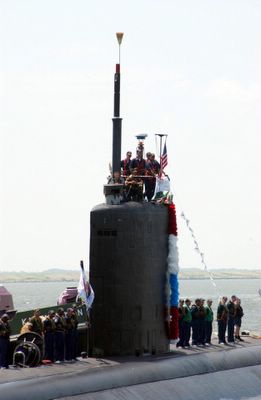
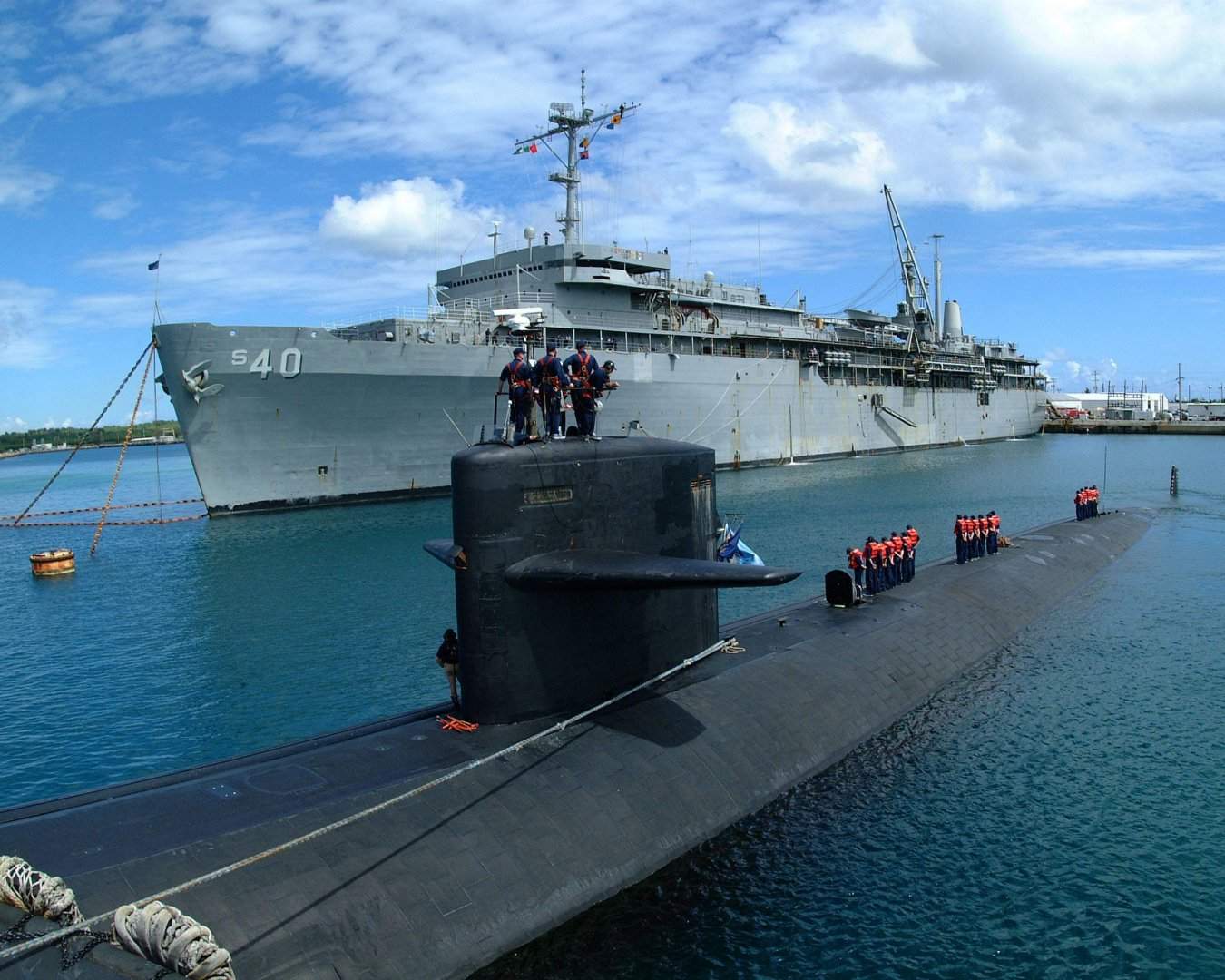
Clean Sweep (Source: US Navy via navsource.org)
Photo is from the USS Montpelier (SSN-765) preparing to moor at Naval Station Norfolk. I choose this Photo as a little poetic justice on my part. Now I wonder if any Subs will end up moving from Norfolk to Groton, only time will tell.
The Brac Commission has voted to take the Submarine Base in New London and the Portsmouth Naval Shipyard off the list of base and facility closures.

Clean Sweep (Source: US Navy via navsource.org)
Photo is from the USS Montpelier (SSN-765) preparing to moor at Naval Station Norfolk. I choose this Photo as a little poetic justice on my part. Now I wonder if any Subs will end up moving from Norfolk to Groton, only time will tell.
Sunday, August 21, 2005
We Build the Best -Submarines
“WE Build thE Best” written in a silhouette of a Submarine, that was the bumper sticker I had on my car in 1978 when I worked for Electric Boat (EB) as a machinist. At the time, EB and Newport News Shipbuilding and Drydock Company (NNS) were prime competitors for the submarine construction business. Newport News had designed and built the lead unit of the 688 class fast attack submarines and Electric Boat was building 688 SSNs and Trident 726 class SSBN submarines. Both yards were producing between one to three 688s a year each. The 688 production run lasted from the late 1970s into the 1990s. During that roughly 20 year timeframe EB produced 33 688 SSNs and 18 726 SSBNs, NNS produced 29 688 SSNs.
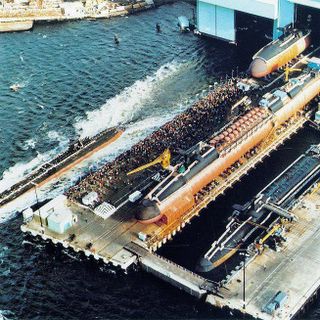
General Dynamics Electric Boat (Source: US Navy Photo)
The last 688, a 688i variant, SSN 773 the USS Cheyenne was delivered to the Navy in September 1996 by NNS. Since then EB has delivered three SSN 21 Seawolf class submarines, was the lead designer of the new Virginia class submarine and delivered the SSN 774 USS Virginia in October of 2004. Newport News has not built another submarine since 1996 until the recent launch of the USS Texas SSN 775 in April of 2005. Newport News Shipbuilding also produces the best Aircraft Carriers in the world, the Nimitz class, of which nine have been built and one is currently in construction.
Therefore, who builds a better submarine General Dynamics Electric Boat or Northrop Grumman Newport News Shipbuilding? I was qualified on and rode two different boats, one built by NNS in 1965 and another built by EB in 1985. Not a fair comparison two different classes with 20 years difference in technology and design. And as I indicated before I was once a EB yardbird, so there is a built in bias here, fair warning in where I’m going with this.
Newport News has always built a quality submarine. The USS San Francisco SSN 711 built by NNS ran into a seamount at a full bell crushing it bow in January. The San Fran may not have survived if not for the quality of its construction and professionalism of the crew. But if being the “Best” means also staying on budget and delivering when contracted to then Newport News get a losing grade. NNS will not deliver the USS Texas to the Navy until May 2006 almost a year after the initial projected delivery date. Newport News Shipyard’s construction of the Texas is also an estimated 24 percent over projected cost.
Lead units are usually problematic and NNS will have had a nearly 10 year hiatus between deliveries of its last two submarines, but the Virginia class is different. In order to maintain two active submarine construction yards, production of the 10 projected Virginia class submarines is being split between EB and NNS with whole systems produced by one or the other. For example, EB will build the ships Command and Control Systems and NNS will build the Weapons Systems. Final submarine assembly will be split between each shipyard EB has completed the USS Virginia and NNS is in the process of completing the USS Texas. This is different from the 688 contracts where each yard did the bulk of its own component fabrication and construction.
Therefore, here is my argument, its not who builds thE Best submarine but who is the better shipyard at submarine construction? Both shipyards have had their share of cost overruns and problems and in the end both build a quality submarine. However, Electric Boat has an advantage in that its only business is in the design and construction of nuclear submarines for the US Navy. Newport News Shipyard builds submarines as well, but also produces Navy surface ships and has an extensive surface ship overhaul and conversion business. Additionally Electric Boat’s Quonset Point facility is dedicated to the quality fabrication of submarine pressure hull sections. In fact, a major portion of the pressure hull sections that NNS will use in the construction of Virginia Class subs will come from Electric Boat Quonset Point. Also recently the Navy has been concerned about NNS construction delays and cost overruns has asked EB to take a more active role as the lead design yard in managing Newport News Shipyard’s Virginia class submarine construction program.
With the current reduced production rate of submarines the Navy is hard pressed to keep two shipyards building submarines efficiently. Therefore, at 1.6 billion the Virginia class submarine was to be a cost saver for the Navy and far cheaper than the 2.8 – 3.0 billion Seawolf class, but the current Virginia class subs are now costing between 2.4 -2.7 billion a copy. With the current procurement rate of one submarine a year that cost could drop to just around 2.0 billion per hull if the build rate were increased to two subs per year. A side note two new subs a year would also keep our force level at it’s current state where as the one per year rate will further reduce the size of the SSN fleet as older 688s are decommissioned.
The Navy has some tough choices. In order to keep a two competitive shipyards producing submarines it must split what a single shipyard could handle easily between two yards. However, this decision comes at the expense of higher production costs. There is no economy of scale in production and smaller regional parts suppliers can no longer be supported by the effective reduction of orders. Additionally the shipyards are forced to retain higher cost engineers and trades people in order to maintain the required instructional skill sets while reducing their work force. These highly skilled shipyard workers end up back filling functions that are below their skill level or worse doing busy work thereby further driving up production costs.
Hopefully the Navy and the two remaining submarine manufactures EB and NNS can made this joint production competition/non-competition thing work. But if not and costs drive procurement rates down like the Seawolf class, from 29 hulls down to only 3 we could some day be saying that a foreign manufacture builds the “Best” submarines in the world.

General Dynamics Electric Boat (Source: US Navy Photo)
The last 688, a 688i variant, SSN 773 the USS Cheyenne was delivered to the Navy in September 1996 by NNS. Since then EB has delivered three SSN 21 Seawolf class submarines, was the lead designer of the new Virginia class submarine and delivered the SSN 774 USS Virginia in October of 2004. Newport News has not built another submarine since 1996 until the recent launch of the USS Texas SSN 775 in April of 2005. Newport News Shipbuilding also produces the best Aircraft Carriers in the world, the Nimitz class, of which nine have been built and one is currently in construction.
Therefore, who builds a better submarine General Dynamics Electric Boat or Northrop Grumman Newport News Shipbuilding? I was qualified on and rode two different boats, one built by NNS in 1965 and another built by EB in 1985. Not a fair comparison two different classes with 20 years difference in technology and design. And as I indicated before I was once a EB yardbird, so there is a built in bias here, fair warning in where I’m going with this.
Newport News has always built a quality submarine. The USS San Francisco SSN 711 built by NNS ran into a seamount at a full bell crushing it bow in January. The San Fran may not have survived if not for the quality of its construction and professionalism of the crew. But if being the “Best” means also staying on budget and delivering when contracted to then Newport News get a losing grade. NNS will not deliver the USS Texas to the Navy until May 2006 almost a year after the initial projected delivery date. Newport News Shipyard’s construction of the Texas is also an estimated 24 percent over projected cost.
Lead units are usually problematic and NNS will have had a nearly 10 year hiatus between deliveries of its last two submarines, but the Virginia class is different. In order to maintain two active submarine construction yards, production of the 10 projected Virginia class submarines is being split between EB and NNS with whole systems produced by one or the other. For example, EB will build the ships Command and Control Systems and NNS will build the Weapons Systems. Final submarine assembly will be split between each shipyard EB has completed the USS Virginia and NNS is in the process of completing the USS Texas. This is different from the 688 contracts where each yard did the bulk of its own component fabrication and construction.
Therefore, here is my argument, its not who builds thE Best submarine but who is the better shipyard at submarine construction? Both shipyards have had their share of cost overruns and problems and in the end both build a quality submarine. However, Electric Boat has an advantage in that its only business is in the design and construction of nuclear submarines for the US Navy. Newport News Shipyard builds submarines as well, but also produces Navy surface ships and has an extensive surface ship overhaul and conversion business. Additionally Electric Boat’s Quonset Point facility is dedicated to the quality fabrication of submarine pressure hull sections. In fact, a major portion of the pressure hull sections that NNS will use in the construction of Virginia Class subs will come from Electric Boat Quonset Point. Also recently the Navy has been concerned about NNS construction delays and cost overruns has asked EB to take a more active role as the lead design yard in managing Newport News Shipyard’s Virginia class submarine construction program.
With the current reduced production rate of submarines the Navy is hard pressed to keep two shipyards building submarines efficiently. Therefore, at 1.6 billion the Virginia class submarine was to be a cost saver for the Navy and far cheaper than the 2.8 – 3.0 billion Seawolf class, but the current Virginia class subs are now costing between 2.4 -2.7 billion a copy. With the current procurement rate of one submarine a year that cost could drop to just around 2.0 billion per hull if the build rate were increased to two subs per year. A side note two new subs a year would also keep our force level at it’s current state where as the one per year rate will further reduce the size of the SSN fleet as older 688s are decommissioned.
The Navy has some tough choices. In order to keep a two competitive shipyards producing submarines it must split what a single shipyard could handle easily between two yards. However, this decision comes at the expense of higher production costs. There is no economy of scale in production and smaller regional parts suppliers can no longer be supported by the effective reduction of orders. Additionally the shipyards are forced to retain higher cost engineers and trades people in order to maintain the required instructional skill sets while reducing their work force. These highly skilled shipyard workers end up back filling functions that are below their skill level or worse doing busy work thereby further driving up production costs.
Hopefully the Navy and the two remaining submarine manufactures EB and NNS can made this joint production competition/non-competition thing work. But if not and costs drive procurement rates down like the Seawolf class, from 29 hulls down to only 3 we could some day be saying that a foreign manufacture builds the “Best” submarines in the world.
Sunday, August 14, 2005
Submarines True Systems of “Transformation”
Consider the following questions:
Do submarines provide a valuable asset to the “Transformation” of the American military into a network-centric fighting force or are they just inflexible relics of the Cold War and 20th century?
What is today’s force level requirement for Submarines? Do we need the Cold War level of roughly 100 SSNs or should we let the submarine force draw down to about 30 boats?
Capt. James H. Patton Jr. USN (Ret.), president of Submarine Tactics and Technology, Inc. and former member of the Naval War College faculty addresses the above questions in a recent Newport Naval War College linked white paper “THE SUBMARINE AS A CASE STUDY IN TRANSFORMATION – Implications for Future Investment.” I recommend reading the entire paper, about five pages, but I've also provided a summary and some thoughts below.
TRANSFORMATION
Mr. Patton’s paper outlines the evolution of the submarine from 1900 to present providing examples of submarine designs adapting to unforeseen requirements. Part of that evolution:
S-Boats designed in the 1920s for coastal defense and fleet boats designed in the 1930s as battle-fleet scouts found themselves in 1942 as distantly deployed commerce raiders.
The Skipjack class, designed to provide terminal guidance for nuclear-tipped Regulus cruise missiles fired from a large fleet of Halibut-class SSGNs, never materialized because of the advent of the Polaris ballistic missile.
The Thresher/Permit-class SSNs, designed to operate in pairs while firing rocket-propelled nuclear depth charges at distant Soviet subs, never carried out that mission, due to the failure of Sesco, a secure acoustic communications system needed for information exchange and the triangulation of sonar bearings for target localization.
Escorting carrier battle groups was the justification for the high speed of the Los Angeles class in the late 1960s. Even though submarines were used in direct support of battle groups in a 1977 Pacific Fleet exercise (RimPac), and a Navy warfare publication was published in 1980 based on further experimentation in RimPacs 1978 and 1979, this mission was not routinely assigned until after the Cold War ended, when many of the class were being decommissioned.
With the above examples and others, Mr. Patton presents an argument in that “To avoid obsolescence, it was sometimes necessary for extreme variant requirements to be made technically (and tactically) during a ship’s (and crew’s) lifetime. As a result it can be safely said that no U.S. submarine has ever been employed for its designed purpose, and no commanding officer ever performed that for which he was trained.” The only exception I would make is that of SSBN Fleet Ballistic Missile submarines who's purpose of nuclear deterrence has not changed since the 1960s only the targeting packages.
But then again, excess 726 Class SSBN capacity post the Cold War has resulted in four Tridents scheduled for conversion to the new Ohio Class SSGN. This will result in adapting a submarine platform from its initial design of nuclear deterrence to one of an Information Systems Research (ISR) intelligence processing node and Special Operation Forces (SOF) platform with land strike capability. A truly network-centric warfare system as Mr. Patton qualifies with using the Giant Shadow and Silent Hammer counterterrorism exercises as examples.

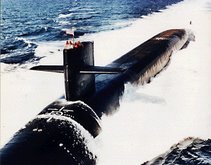
USS Virginia (Source: US Navy)
Another point made in the white paper is this:
“It should also be clear, to those who think deeply about such matters, that the SSGN program is far more than just a way to extend the operational viability of declining SSBNs; it is a pilot program to investigate just what the Virginia class should become when it has fully evolved in ten years.”
Essentially the Ohio SSGN program is a proving ground for technologies and tactics that well evolve and be incorporated into the new Virginia class submarines.
FORCE LEVEL
The latter part of the Mr Patton's paper briefly addresses the number of submarines we will require for our furture submarine force "Force-Level" with this.
However, with the world situation becoming increasingly unstable, there are more than one or two places where a credible, actual, or virtual U.S. presence must be claimed or maintained. Therefore, to sustain persistently unseen assets around the world, there is a force-level number that must be maintained. This number is significantly more than thirty, the level resulting from a one-per-year build rate of thirty three-year-design-life hulls, when operating tempos, maintenance, and transits are factored in. All post–Cold War submarine force level studies by several agencies indicate an enduring need for numbers of SSNs far in excess of what can be sustained by a one-per-year build rate.
I think what unstable areas Mr. Patton alludes to is obviously the Middle East and Western Pacific. But without long forward deployments a SSN force of 30 hulls, with some in the shipyard some deployed for carrier taskforce ASW protection and some in port, the Navy would be hard pressed to “sustain persistently unseen assets around the world”.
It is stated in the paper that "SSN taskings by fleet and national commanders have essentially doubled since the end of the Cold War" even though the force level of SSNs has dropped from 100 to roughly 50 today. The predicted affect is: “Because of this submarine shortage, existing ships must now transit at much higher sustained speeds than originally planned, which threatens the life span of their reactors.” If this is true then SSNs would be heading to the shipyard sooner for refueling thereby putting addition pressure on our existing submarine assets.
Conclusion
To me all the above (Submarine systems adaptability and increased force requirements and tasking) seems to run counter to the current DOD and Navy decisions with regards to the New London Sub Base being on the Brac list and the reduced build rate for the Virginia class Subs. My concern is that the powers that be (budgetary and political) may indeed hurt Submarine Force and lessen this country’s ability to defend itself.
Thursday, August 11, 2005
Film of the Shot of the Day
Back a little over a week ago I had a "Shot of the Day" featuring the USS Pilotfish (SS-386) resting in 175 feet of water at the bottom of the Bikini Atoll. It as well as other ships were sunk as part of atomic bomb testing in July 1946 and are now dive destinations.
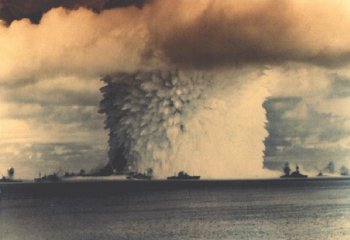
Operation Crossroads Baker Shot (Source: DOE)
I ran across some film of the Operation Crossroads Baker shot (National Geographic HERE or the DOE HERE) that resulted in the test target USS Pilotfish, moored at a depth of 168 feet and at a range of 363 yards from the point of the blast, in sinking. Only 21 of the 71 ships in the Able and Baker tests actually sank but all sustained damage. If not sunk during the tests the remaining ships were heavily contaminated with radiation and were either scuttled, sunk in gunnery exercises or scrapped.
The Baker shot was a 21-kiloton shallow water test detonated some ninety feet underwater and was the final weapon test conducted as part of the original Manhattan Project.
Operation Crossroads Baker Shot (Source: DOE)
I ran across some film of the Operation Crossroads Baker shot (National Geographic HERE or the DOE HERE) that resulted in the test target USS Pilotfish, moored at a depth of 168 feet and at a range of 363 yards from the point of the blast, in sinking. Only 21 of the 71 ships in the Able and Baker tests actually sank but all sustained damage. If not sunk during the tests the remaining ships were heavily contaminated with radiation and were either scuttled, sunk in gunnery exercises or scrapped.
The Baker shot was a 21-kiloton shallow water test detonated some ninety feet underwater and was the final weapon test conducted as part of the original Manhattan Project.
Monday, August 08, 2005
My Russian Watch is Broken
About a year and a half ago, I purchased a Russian Submariner's watch over the internet. Sometime after I started wearing it I showed it to Vika a programmer originally from Russia who works for the same company as I do. She had two comments; the first was "You bought Russian watch?", with a look on her face of disbelief, followed by "Don't get it wet". I also found out that what was advertised as a self-winding watch meant you wind it yourself (Must have been a translation problem).

Hey, I thought it looked cool anyway and I needed a watch at the time. Live and learn, the watch's winding stem fell off two months ago. I've changed country and service branch since, my new watch is a Swiss Army.
Therefore, when I saw this headline "Navy team given Russian wristwatches for sub rescue" (Hat tip: TheSubReport) My first thought was, I hope they get something of better quality, followed by Vika's recommendation "Don't get it wet" which I'm thinking could also apply to the current state of the Russian Navy.

Hey, I thought it looked cool anyway and I needed a watch at the time. Live and learn, the watch's winding stem fell off two months ago. I've changed country and service branch since, my new watch is a Swiss Army.
Therefore, when I saw this headline "Navy team given Russian wristwatches for sub rescue" (Hat tip: TheSubReport) My first thought was, I hope they get something of better quality, followed by Vika's recommendation "Don't get it wet" which I'm thinking could also apply to the current state of the Russian Navy.
Sunday, August 07, 2005
I was Four Striper for Four Minutes Today
Actually two four stripers (CAPTs), so here is how it happened. I went to the Russian Juliett 484 in Providence today as I do every weekend. I try to put in a good 4 or 5 hours on my new pet restoration project, the starboard outboard diesel powered 4 stage high pressure air compressor. It’s in the engine room upper level just forward of the 3,500HP starboard main diesel.
The restoration work is dirty so I wear steel toe work boots, old blue jeans, a tee shirt, ball cap and safety glasses. The manager of the Juliett has asked the Subvets that volunteer to wear something to add color to the tours. Some of the docents wear Russian seaman shirts and hats. I’ve been doing maintenance work so I wear a tee shirt and ball cap with silver dolphins and saying simply “US Submarine Force – Silent Service”. My real job has me at a computer all day so getting down in the bilges, so to speak, and using a wire brush and scrapper feels good (as long as its my idea) and telling a sea story to a passing inquisitive tourist is, well, sort of like blogging in person. But I digress….
I had been working for about two hours and was getting hot so I got my can of ginger ale and went topside. One of the Russian subs watch standers (employee) was busy bringing up folding chairs from below decks for a Senior Chief Sonarmen’s retirement ceremony. With only one person from the Juliett doing the setup I stepped in to assist. Because of the number of the attendees 30-40 with some elderly or in a wheelchair we decided to set things up on the pier verses the Juliett’s missile deck. Within 45 minutes, everything was setup and ready to go chairs, podium, Colors, big quarterdeck shells and sideboys complete with bosun’s pipe. OK, back below for this civilian to continue my bilge therapy session.
Not so fast, time for a quick rehearsal and they need someone to fill in and be piped aboard. So yours truly is enlisted once again, this time as a couple of COMSUB or SUBRON somethings (Squadron Twelve was one I think, sorry didn’t pay attention). Must have been a site, me looking like an A-Gang striker covered head to foot in Russian pigboat dirt, being piped aboard with sideboys and all, had a little chuckle to myself.
Ceremony looked like it went off without a hitch.
Best of luck Senior Chief and thanks for your service.
The restoration work is dirty so I wear steel toe work boots, old blue jeans, a tee shirt, ball cap and safety glasses. The manager of the Juliett has asked the Subvets that volunteer to wear something to add color to the tours. Some of the docents wear Russian seaman shirts and hats. I’ve been doing maintenance work so I wear a tee shirt and ball cap with silver dolphins and saying simply “US Submarine Force – Silent Service”. My real job has me at a computer all day so getting down in the bilges, so to speak, and using a wire brush and scrapper feels good (as long as its my idea) and telling a sea story to a passing inquisitive tourist is, well, sort of like blogging in person. But I digress….
I had been working for about two hours and was getting hot so I got my can of ginger ale and went topside. One of the Russian subs watch standers (employee) was busy bringing up folding chairs from below decks for a Senior Chief Sonarmen’s retirement ceremony. With only one person from the Juliett doing the setup I stepped in to assist. Because of the number of the attendees 30-40 with some elderly or in a wheelchair we decided to set things up on the pier verses the Juliett’s missile deck. Within 45 minutes, everything was setup and ready to go chairs, podium, Colors, big quarterdeck shells and sideboys complete with bosun’s pipe. OK, back below for this civilian to continue my bilge therapy session.
Not so fast, time for a quick rehearsal and they need someone to fill in and be piped aboard. So yours truly is enlisted once again, this time as a couple of COMSUB or SUBRON somethings (Squadron Twelve was one I think, sorry didn’t pay attention). Must have been a site, me looking like an A-Gang striker covered head to foot in Russian pigboat dirt, being piped aboard with sideboys and all, had a little chuckle to myself.
Ceremony looked like it went off without a hitch.
Best of luck Senior Chief and thanks for your service.
Bad Air and AS-28 Submersible Rescue
During this crisis, there had been ongoing conflicting reports on how much air the trapped crew of AS28 had to survive on. Bubblehead noted this here in a Reuters article from early Saturday:
"We must complete the operation in 24 hours because the supply of air on board is not without limit," Interfax news agency quoted the deputy chief of navy staff, Vladimir Pepelyaev, as saying.
"It is believed that there is still enough air for slightly more than 24 hours," Pepelyaev added. Initial offical reports said the AS-28, itself a rescue vessel, ran into trouble when its propeller became entangled in fishing nets during a military exercise. They said it had five days' supply of air -- more than enough for any rescue mission.
However, about 1100 BST on Friday, naval spokesman Igor Dygalo said the trapped vessel had only 24 hours' worth of air left. There was no official explanation why estimates of air remaining still stood at 24 hours on Saturday morning.
This submersible was primarily submarine rescue vehicle and therefore the crew would have been trained in all aspects of submarine rescue problems, including air quality and conservation. Once the crew knew that they needed to await outside rescue that training would have kicked in and may have been what pushed the air supply to the more optimistic estimates.
If my experience with doing restoration work on the old Soviet Juliett 484 is any indication the Russians kept an ample supply of lithium hydroxide for CO2 absorption. They may also have kept chlorite candles chemically similar to what is in an OBA for emergency O2 generation on board their submarines. It would be reasonable to think that this practice would include a submarine rescue submersible if not for its own use then to supplement a submarine on the bottom. Any submarine rescue vehicle would require multiple trips to a stricken submarine to effect a complete crew rescue.
As far as the political air is concerned, Putin and some Russian admirals can get some sleep tonight. It would have been a political crisis similar to that of the Kursk if things had come out differently, for the sake of the AS-28 crew, thank god and the Brits ROV team it didn't.
"We must complete the operation in 24 hours because the supply of air on board is not without limit," Interfax news agency quoted the deputy chief of navy staff, Vladimir Pepelyaev, as saying.
"It is believed that there is still enough air for slightly more than 24 hours," Pepelyaev added. Initial offical reports said the AS-28, itself a rescue vessel, ran into trouble when its propeller became entangled in fishing nets during a military exercise. They said it had five days' supply of air -- more than enough for any rescue mission.
However, about 1100 BST on Friday, naval spokesman Igor Dygalo said the trapped vessel had only 24 hours' worth of air left. There was no official explanation why estimates of air remaining still stood at 24 hours on Saturday morning.
This submersible was primarily submarine rescue vehicle and therefore the crew would have been trained in all aspects of submarine rescue problems, including air quality and conservation. Once the crew knew that they needed to await outside rescue that training would have kicked in and may have been what pushed the air supply to the more optimistic estimates.
If my experience with doing restoration work on the old Soviet Juliett 484 is any indication the Russians kept an ample supply of lithium hydroxide for CO2 absorption. They may also have kept chlorite candles chemically similar to what is in an OBA for emergency O2 generation on board their submarines. It would be reasonable to think that this practice would include a submarine rescue submersible if not for its own use then to supplement a submarine on the bottom. Any submarine rescue vehicle would require multiple trips to a stricken submarine to effect a complete crew rescue.
As far as the political air is concerned, Putin and some Russian admirals can get some sleep tonight. It would have been a political crisis similar to that of the Kursk if things had come out differently, for the sake of the AS-28 crew, thank god and the Brits ROV team it didn't.
Friday, August 05, 2005
Been on watch - since Wed.
I have been the single parent since the middle of the week with the significant other in DC at a conference, that means kid duty. So, I haven't been able to follow the Russian Bathyscaphe AS-28 story closely. Looks like Pig Boat Sailor and Bubblehead have been consolidating the news and keeping on top of things on their blogs as well as at Ultraquite No More. Check my submariners blogroll for others that may have additional info.
Sorry about no updates here but it's been chicken nuggets, popsicles and tubbies for three days. Makes for a bad blogging schedule.
Sorry about no updates here but it's been chicken nuggets, popsicles and tubbies for three days. Makes for a bad blogging schedule.
Monday, August 01, 2005
Microsoft has a Navy now??
No, But Microsoft co-founder Paul Allen has $200 million private yacht in construction that sounds like a Navy ship. In a CNN/Money piece "Superyachts of the CEOs" Allen's yacht is described as such:
Imagine yourself cruising the high seas in a lavish, super-secret ocean-faring vessel complete with a remote controlled undersea rover, a 12-man submersible and a personal crew of 60, including several former Navy Seals and a recording studio.
First off I didn't know Navy Seals could sing, unless they were really drunk, nevermind be good enough to record!!! Paul Allen's 416-foot boat named Octopus has some other nice warship like features including:
Imagine yourself cruising the high seas in a lavish, super-secret ocean-faring vessel complete with a remote controlled undersea rover, a 12-man submersible and a personal crew of 60, including several former Navy Seals and a recording studio.
First off I didn't know Navy Seals could sing, unless they were really drunk, nevermind be good enough to record!!! Paul Allen's 416-foot boat named Octopus has some other nice warship like features including:
- Garage with a 4x4 vehicle (maybe a Hummer, up-armored of course)
- Transport craft to take the 4X4 to the beach (amphibious I'm guessing)
- Two helicopter pads (no waiting for the flight back to headquarters)
- Under hull docked 12 man submersible (stealth is key for the super rich)
- Staff of former Navy Seals (for the south asian software pirates I presume)
Not to be outdone Larry Ellison CEO of Oracle has a larger 452-foot superyacht named Rising Sun also in construction.
I guess this is what you buy when the money flows like water into your bank account. Not to complain or anything but, I'd be happy with just one of their old leaky sub accounts and a used Boston Whaler......
Sunday, July 31, 2005
Shot of the Day
The USS Pilotfish (SS-386) was used as a target for the Operation Crossroads atomic bomb test at Bikini Atoll in July 1946 and lies in 175 feet of water.

USS Pilotfish (SS-386) Bikini Atoll
(Source: US National Park Service)
The USS Pilotfish as well as the USS Apogon (SS-308) are among a number of wrecks from the nuclear tests that are now dive destinations.

USS Pilotfish (SS-386) Bikini Atoll
(Source: US National Park Service)
The USS Pilotfish as well as the USS Apogon (SS-308) are among a number of wrecks from the nuclear tests that are now dive destinations.
Friday, July 29, 2005
Russian Nuclear Barges???
The TimesOnline in the UK is reporting in this piece “Safety fear overruled for Putin's floating reactors” that the Russians are planning to build floating nuclear power plants. The intent is to provide electricity to remote northern ports that are inaccessible by road. An excerpt:
Each floating plant will house a 70 megawatt reactor similar to that on a nuclear submarine, or icebreaker, and big enough to power a city of 200,000 people. They will probably be assembled in St Petersburg, Russia’s second city, before being towed to their destinations around the coast.
The far eastern regions of Kamchatka and Chukotka — governed by the oil tycoon Roman Abramovich — have already signed up for one each and other regions are expected to follow. Each plant is designed to last 40 years and will cost about $200 million (£115 million).
China signed a $86.5 million deal this week to build the boat for the first one, while Russia will construct the reactor block. Russia also plans to export plants to China, Thailand, Indonesia, the Middle East and even Canada.
The TimesOnline article brings up some valid concerns especially when it comes to the Russians. The first concern being the poor environmental record the Russians have with nuclear power. (Although using the Kursk for an example of this doesn't quite fit the theme of the piece) I posted similar environmental concerns on a different nutty Russian proposal regarding Nuclear Submarine disposal back in April.
The second problem is related to the first in that they claim the reactor will be 9/11 style terrorist attack hardened and therefore safe from an environmental disaster. A hardened reactor for just $200 Million a pop, that doesn’t sound right. But then they intend to put floating reactors up for sale to the MIDDLE EAST!!! So I guess the real strategy is, don’t fly planes into our reactors and we’ll just sell you one of your own. How do you say "proliferation risk" in russian?
Portable nuclear power plants moved by ship/barge is an interesting concept if it didn't come from government that is broke, corrupt and sliding back to authorianism. Any thoughts from the maneuvering watchstanders?
Each floating plant will house a 70 megawatt reactor similar to that on a nuclear submarine, or icebreaker, and big enough to power a city of 200,000 people. They will probably be assembled in St Petersburg, Russia’s second city, before being towed to their destinations around the coast.
The far eastern regions of Kamchatka and Chukotka — governed by the oil tycoon Roman Abramovich — have already signed up for one each and other regions are expected to follow. Each plant is designed to last 40 years and will cost about $200 million (£115 million).
China signed a $86.5 million deal this week to build the boat for the first one, while Russia will construct the reactor block. Russia also plans to export plants to China, Thailand, Indonesia, the Middle East and even Canada.
The TimesOnline article brings up some valid concerns especially when it comes to the Russians. The first concern being the poor environmental record the Russians have with nuclear power. (Although using the Kursk for an example of this doesn't quite fit the theme of the piece) I posted similar environmental concerns on a different nutty Russian proposal regarding Nuclear Submarine disposal back in April.
The second problem is related to the first in that they claim the reactor will be 9/11 style terrorist attack hardened and therefore safe from an environmental disaster. A hardened reactor for just $200 Million a pop, that doesn’t sound right. But then they intend to put floating reactors up for sale to the MIDDLE EAST!!! So I guess the real strategy is, don’t fly planes into our reactors and we’ll just sell you one of your own. How do you say "proliferation risk" in russian?
Portable nuclear power plants moved by ship/barge is an interesting concept if it didn't come from government that is broke, corrupt and sliding back to authorianism. Any thoughts from the maneuvering watchstanders?
Highway Bill to Detour previous Brac closing
The Washington Post has an AP report that congress is on the verge of approving $286.4 billion in highway bill and as always highway appropriations means funding pig crossings, the congressional pork kind. Buried in the bill is something that has got Rep. Christopher Shays, R-Conn. a little upset.
Excerpt From the AP:
Sen. Max Baucus (Mont.), the top Democrat on the Finance Committee, said he succeeded in inserting a provision in the bill to reopen a closed runway at Malmstrom Air Force Base.
With this the reported reaction:
Rep. Christopher Shays, R-Conn., whose own state could lose a submarine base at Groton under the latest round of proposed base closings, said it was "absolutely outrageous" that the highway bill was being used to reverse a previous decision on closing a military facility.
Isn't politics interesting, a blue state Republican, whose state may loose a major military installation under a Republican administration, is complaining about a red state Democrat's tactic to reopen a military installation closed under a Democrat administration.
Anyone else see the ironic twist in this?
Excerpt From the AP:
Sen. Max Baucus (Mont.), the top Democrat on the Finance Committee, said he succeeded in inserting a provision in the bill to reopen a closed runway at Malmstrom Air Force Base.
With this the reported reaction:
Rep. Christopher Shays, R-Conn., whose own state could lose a submarine base at Groton under the latest round of proposed base closings, said it was "absolutely outrageous" that the highway bill was being used to reverse a previous decision on closing a military facility.
Isn't politics interesting, a blue state Republican, whose state may loose a major military installation under a Republican administration, is complaining about a red state Democrat's tactic to reopen a military installation closed under a Democrat administration.
Anyone else see the ironic twist in this?
Wednesday, July 27, 2005
It wasn’t me Copper! I’m a Navy Veteran
Ever dig up odd facts on the internet, here is a little bit of Navy trivia for you.
Today is the anniversary of John Herbert Dillinger “Public Enemy #1” joining the US Navy.
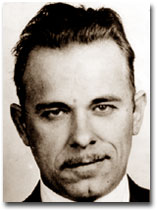
Would you call this man Shipmate?
(Source: FBI)
Dillinger joined the Navy on July 27, 1923 to avoid charges of auto theft in Indiana and went to basic at the Great Lakes Naval Training Facility. He was later assigned to the ill fated USS Utah (BB-31).
The Navy life did not agree with Dillinger. Five months after enlisting, the man who would become America's most wanted bank robber, deserted the Navy on December 4, 1923 when the USS Utah docked in Boston MA.
A quick timeline of Dillinger's crime career, including his going AWOL from the Navy, can be found here.
As far as my research can tell, there is no truth to the rumor that Dillinger took the XO's door on the way off the USS Utah.
Today is the anniversary of John Herbert Dillinger “Public Enemy #1” joining the US Navy.
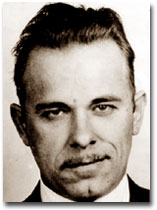
Would you call this man Shipmate?
(Source: FBI)
Dillinger joined the Navy on July 27, 1923 to avoid charges of auto theft in Indiana and went to basic at the Great Lakes Naval Training Facility. He was later assigned to the ill fated USS Utah (BB-31).
The Navy life did not agree with Dillinger. Five months after enlisting, the man who would become America's most wanted bank robber, deserted the Navy on December 4, 1923 when the USS Utah docked in Boston MA.
A quick timeline of Dillinger's crime career, including his going AWOL from the Navy, can be found here.
As far as my research can tell, there is no truth to the rumor that Dillinger took the XO's door on the way off the USS Utah.
Saturday, July 23, 2005
Coryphaenidae Qualified Kleptomania
Coryphaenidae qualified kleptomania or dolphin fish qualified thievery.
Submarine enlisted crewmembers have been known to from time to time procure a certain luxury item from the Executive Officer without his prior knowledge. Said item affords the XO a level of needed privacy while underway. The selection and gratuitous theft of this item seems to be a bit of a tradition in the Submarine Service.
All you Submariners out there know exactly what I’m writing about it’s……. “Who took the XO’s door!!!!”

Where the F*^*#$% is my door?!!!!!
In the past and present, I've had a number of shipmates and friends relate theirs and others stories of XO stateroom doors that have gone missing. Here’s a few presented purely for their entertainment value (Active duty, please this is not a meant to be a how to guide).
My story:
I was a on my first patrol on the Simon Bolivar SSBN641 and we had been underway for about a month. Off watch and studying my ships Quals I had found the upper level electronic room forward of sonar a quiet place to read ship systems manuals. After about a half hour of study I was suddenly interrupted by a QM2(SS) standing in the passageway with the XO’s door. He proceeded to quickly slide the door behind a large sonar equipment cabinet just inside the electronics room door, put his finger to his lips and went Sssssss and left.
Not 10 to 15 minutes later I’m interrupted a second time, this time it’s the Chief of the Boat COB. He looks at me and says, “The XO’s pissed and wants his door back, I know someone in NAV division took it, do you know who and where it is.” I said “No COB, don’t know a thing, just been sitting here studying my Quals.” If it was a snake it would have bit him, but he didn’t see it and went on with the search.
I little while later I went to the control room and found the watch section discussing the missing door, a busy QM2(SS) was the only one not participating in the conversation. The door was found a few days later just before Halfway Night.
Ric Hedman manager of Juliett 484 had this story for me today:
As Ric tells it on the USS Flasher SSN613 the XO's stateroom door went AWOL during the maneuvering watch while heading out on patrol. The XO stationed a someone outside his stateroom to verify that anyone entering the passageway had to either have the CO or his permission to be there. Ric being a Stewards MateTN(SS) was the only one who had a blanket permission. This went on for the entire patrol and no door. Finally at the end of patrol and, of course during the maneuvering watch, the XO's door was retrieved from the freezer, frozen solid, and returned its proper location. The ice that accumulated in the XO's door promptly melted ruining the fine wool carpets that were donated and installed in the boat during construction. The XO was not pleased.
Stories from others I found searching the internet:
From the USS Memphis guestbook.
"I remember stealing the XO's door and hiding it in ERUL outboard the Port Main Engine. After the Wardroom poker game broke up the XO went up to his state room (sp?) then got on the 1MC and ordred field day until his door was found and returned. That was a great night. Soaking Ens. Grosicki and the Engineer between the MSW Pumps was very satisfying too. Looking back, I can say the time I spent on MEMPHIS was a great time of my life.
Sincerely, "Spit"MM1(SS) Scott Benson"
From the USS Spinax newsletter page. or Submarine Sailor.com humor page
"On board the Robert E. Lee SSBN601B, the crew stole the XO"s door. The next day's POD said there were to be no movies until it was returned. For privacy the XO, E.O. Warren hung a blanket over the opening.
By the 3rd day he had gotten into the habit of walking thru the blanket instead of moving it. On the 5th day we replaced the door. Re-hanging the blanket over it, and then settled back to watch the fun.
Suddenly the XO came running down the passageway enroute to his stateroom and thru the blanket/curtain, coming up very short upon meeting the door. Nose bleeding and demanding an answer, the CO came to his rescue.
After surveying the damage the CO, R.W.Aldinger, marched to control, grasped the 1MC and announced, "This is the Captain. The XO's door has been found. MOVIE CALL!"
W.S. Wantland QMC(SS) USS Hawkbill SSN 666"
Sea stories on spookgroup.tripod.com
"From LCDR(Ret) John Arnold
On Halibut, after our 2nd back-to-back Ivy Bells mission, my 4 Chiefs were bored and up to mischief on our return to CONUS. They stole the CO's stateroom door. The CO had the XO's door transfered to his stateroom & told the XO he didn't care if they ever found the door. Needless to say the XO was ticked. Each watch section had a search/recovery team looking in vain for the elusive door. To add insult to injury, the spook Chiefs re installed the (missing for 10 days) door on the XO's stateroom. All of this accomplished without discovery or even a clue as to who pulled off this great TF. It wasn't until our mission debrief at NSA that we revealed the Mystery to the skipper-Chuck Larsen. I've heard that other ships have tried this but the door has always been found and many times the culprit is caught in the act of removing the door. These guys were a cleaver team aside from providing NSA with hundreds of the finest broadband tapes that they had ever received! "
SSBN622 homestead Sea Stories webpage
"I was stationed on the Monroe from 1979 to 1983. The XO at the time had a thing about DYNO labels being around the boat. The officers aboard got together and put labels all over his stateroom. He didn't know who did it but he blamed the nukes on board and made them do an extra field day. Then a A-Gang member stole his stateroom door and hid it. One thing to remember is that we were underway and we couldn't compact it. The XO went for three days searching for the door and couldn't find it until he made some A-Ganger act as a door until the door showed up. The XO apologized to the nukes and we allowed him to bring us bug juice for a couple of shifts.
Robert Crowe "
A couple of good ones from a Military.com forum
"one halfway night the XO's door showed up, with the ENG taped to it. Carried by 2 MM1's. Now that was a halfway night."
and this
"I got an old door from salvage one time and cut it into a jig saw puzzle. Took the XO's door at halfway night and put the pieces on his rack. He really freeked. We hid his real door under the deck plates in the crew's library, you know how many screws there are in those deck plates? (Lafayette Class 616) Takes hours..."
And finally this about not taking the door
"There was one time the door did not disappear. The XO at the time had a thing about flickering fluorescent light bulbs and was constantly combing the boat for 'em. Pissed E Div off to no end.Anyway, the XO comes back from halfway night festivities to find his door still there, he's shocked and amazed. He opens the door to his stateroom and flicks on the lights. Every bulb had been replaced with the flickering lights he made E div change out."
If anyone has their own story of an UNHINGED XO door or otherwise just add to the Comments section.
Submarine enlisted crewmembers have been known to from time to time procure a certain luxury item from the Executive Officer without his prior knowledge. Said item affords the XO a level of needed privacy while underway. The selection and gratuitous theft of this item seems to be a bit of a tradition in the Submarine Service.
All you Submariners out there know exactly what I’m writing about it’s……. “Who took the XO’s door!!!!”

Where the F*^*#$% is my door?!!!!!
In the past and present, I've had a number of shipmates and friends relate theirs and others stories of XO stateroom doors that have gone missing. Here’s a few presented purely for their entertainment value (Active duty, please this is not a meant to be a how to guide).
My story:
I was a on my first patrol on the Simon Bolivar SSBN641 and we had been underway for about a month. Off watch and studying my ships Quals I had found the upper level electronic room forward of sonar a quiet place to read ship systems manuals. After about a half hour of study I was suddenly interrupted by a QM2(SS) standing in the passageway with the XO’s door. He proceeded to quickly slide the door behind a large sonar equipment cabinet just inside the electronics room door, put his finger to his lips and went Sssssss and left.
Not 10 to 15 minutes later I’m interrupted a second time, this time it’s the Chief of the Boat COB. He looks at me and says, “The XO’s pissed and wants his door back, I know someone in NAV division took it, do you know who and where it is.” I said “No COB, don’t know a thing, just been sitting here studying my Quals.” If it was a snake it would have bit him, but he didn’t see it and went on with the search.
I little while later I went to the control room and found the watch section discussing the missing door, a busy QM2(SS) was the only one not participating in the conversation. The door was found a few days later just before Halfway Night.
Ric Hedman manager of Juliett 484 had this story for me today:
As Ric tells it on the USS Flasher SSN613 the XO's stateroom door went AWOL during the maneuvering watch while heading out on patrol. The XO stationed a someone outside his stateroom to verify that anyone entering the passageway had to either have the CO or his permission to be there. Ric being a Stewards MateTN(SS) was the only one who had a blanket permission. This went on for the entire patrol and no door. Finally at the end of patrol and, of course during the maneuvering watch, the XO's door was retrieved from the freezer, frozen solid, and returned its proper location. The ice that accumulated in the XO's door promptly melted ruining the fine wool carpets that were donated and installed in the boat during construction. The XO was not pleased.
Stories from others I found searching the internet:
From the USS Memphis guestbook.
"I remember stealing the XO's door and hiding it in ERUL outboard the Port Main Engine. After the Wardroom poker game broke up the XO went up to his state room (sp?) then got on the 1MC and ordred field day until his door was found and returned. That was a great night. Soaking Ens. Grosicki and the Engineer between the MSW Pumps was very satisfying too. Looking back, I can say the time I spent on MEMPHIS was a great time of my life.
Sincerely, "Spit"MM1(SS) Scott Benson"
From the USS Spinax newsletter page. or Submarine Sailor.com humor page
"On board the Robert E. Lee SSBN601B, the crew stole the XO"s door. The next day's POD said there were to be no movies until it was returned. For privacy the XO, E.O. Warren hung a blanket over the opening.
By the 3rd day he had gotten into the habit of walking thru the blanket instead of moving it. On the 5th day we replaced the door. Re-hanging the blanket over it, and then settled back to watch the fun.
Suddenly the XO came running down the passageway enroute to his stateroom and thru the blanket/curtain, coming up very short upon meeting the door. Nose bleeding and demanding an answer, the CO came to his rescue.
After surveying the damage the CO, R.W.Aldinger, marched to control, grasped the 1MC and announced, "This is the Captain. The XO's door has been found. MOVIE CALL!"
W.S. Wantland QMC(SS) USS Hawkbill SSN 666"
Sea stories on spookgroup.tripod.com
"From LCDR(Ret) John Arnold
On Halibut, after our 2nd back-to-back Ivy Bells mission, my 4 Chiefs were bored and up to mischief on our return to CONUS. They stole the CO's stateroom door. The CO had the XO's door transfered to his stateroom & told the XO he didn't care if they ever found the door. Needless to say the XO was ticked. Each watch section had a search/recovery team looking in vain for the elusive door. To add insult to injury, the spook Chiefs re installed the (missing for 10 days) door on the XO's stateroom. All of this accomplished without discovery or even a clue as to who pulled off this great TF. It wasn't until our mission debrief at NSA that we revealed the Mystery to the skipper-Chuck Larsen. I've heard that other ships have tried this but the door has always been found and many times the culprit is caught in the act of removing the door. These guys were a cleaver team aside from providing NSA with hundreds of the finest broadband tapes that they had ever received! "
SSBN622 homestead Sea Stories webpage
"I was stationed on the Monroe from 1979 to 1983. The XO at the time had a thing about DYNO labels being around the boat. The officers aboard got together and put labels all over his stateroom. He didn't know who did it but he blamed the nukes on board and made them do an extra field day. Then a A-Gang member stole his stateroom door and hid it. One thing to remember is that we were underway and we couldn't compact it. The XO went for three days searching for the door and couldn't find it until he made some A-Ganger act as a door until the door showed up. The XO apologized to the nukes and we allowed him to bring us bug juice for a couple of shifts.
Robert Crowe "
A couple of good ones from a Military.com forum
"one halfway night the XO's door showed up, with the ENG taped to it. Carried by 2 MM1's. Now that was a halfway night."
and this
"I got an old door from salvage one time and cut it into a jig saw puzzle. Took the XO's door at halfway night and put the pieces on his rack. He really freeked. We hid his real door under the deck plates in the crew's library, you know how many screws there are in those deck plates? (Lafayette Class 616) Takes hours..."
And finally this about not taking the door
"There was one time the door did not disappear. The XO at the time had a thing about flickering fluorescent light bulbs and was constantly combing the boat for 'em. Pissed E Div off to no end.Anyway, the XO comes back from halfway night festivities to find his door still there, he's shocked and amazed. He opens the door to his stateroom and flicks on the lights. Every bulb had been replaced with the flickering lights he made E div change out."
If anyone has their own story of an UNHINGED XO door or otherwise just add to the Comments section.
Friday, July 22, 2005
BBC writes about blogging - I SPY a Submarine
The BBC has an article today titled "Digital Citizens: Your creativity" with a short run of examples of blogs by English citizens. One caught my eye STEVE GOES TRAVELLING with an entry the BBC decided to show about Steve finding a captured North Korean Submarine.
And I thought that Bubblehead at The Stupid Shall Be Punished and Eric at The Sub Report got all the submarine news scoops! Perhaps going to "Gangneung for what seemed to be a never ending quest for a beer" as Steve did, is the way to go.
And I thought that Bubblehead at The Stupid Shall Be Punished and Eric at The Sub Report got all the submarine news scoops! Perhaps going to "Gangneung for what seemed to be a never ending quest for a beer" as Steve did, is the way to go.
Monday, July 18, 2005
Class Struggle
When it comes to funding new classes of ships the US Navy is in a difficult position these days. Greater per unit procurement costs, budget constraints, mission requirements and the need to maintain a shipbuilding industrial base are all factors that must be taken into account when embarking on creating a new class of ship. In many cases the design and development of a new class of ship has a lead time of a decade or more of engineering work before construction starts. During that time technology advances and even operational requirements can change.
Here's a couple of examples of how a ship's design, development and construction process can go poorly or pretty well.
The Navy's newest class of amphibious ships is getting bad reviews by Navy inspectors in recent months. The USS San Antonio is a $1.2 billion helicopter and troop carrier schedule to join the fleet this fall.
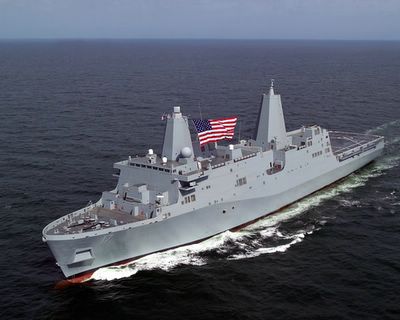
USS San Antonio LPD17 (Source: US Navy)
The HamptonRoads.com article titled "Problems on new ship a bad sign, analyst warns" states:
The ''poor construction and craftsmanship'' Navy inspectors say they found last month aboard a new amphibious ship could be an ominous sign for the service and the U.S. shipbuilding industry as they embark on a host of other ship programs, a veteran naval analyst warned Wednesday.
Additionally there's this statement:
Inspectors said they found such deficiencies as hazardous wiring, uninstalled ventilation and a crash-prone engineering control system. Though the Navy expects to take possession of the ship in August, the inspectors said the San Antonio is not ready for its crew to come aboard.
That's troubling, the ship is not ready for the crew to come aboard? I know what they really mean is become operational, she's already manned, but the Navy has a problem here and it sounds like another poorly run program and problems with the Shipbuilder.
Joseph F. Yurso a former commander of the Portsmouth Naval Shipyard in Kittery, Maine is quoted in the above article as saying "A nuclear-powered submarine or aircraft carrier receiving its first exam from the Board of Inspection and Survey generally gets fairly high marks". But then goes on to argue that amphibious ships always seem to be at the end of a food chain. What I can't understand is the price tag, $1.2 Billion for a conventionally powered (diesel) ship that looks like a big sub tender, how is that the end of the food chain?
But Mr. Yurso brings up a good point, at least in recent history, that new class submarine programs seem to have the good record. In contrast take progress of the new Virginia Class SSN as reported in The New London Day back in June:
The Groton-based USS Virginia could deploy later this year, more than a year ahead of what would be a typical schedule, becoming the first nuclear submarine to go on an official mission before a year of testing and a year of repair, top Navy officials said this week.
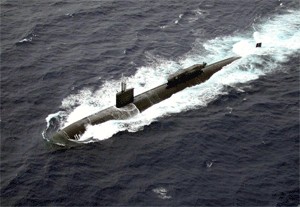
Virginia Class Submarine (Source: US Navy)
A few of my fellow bubbleheads have commented on the USS Virginia's program success back then, such as here and here as well as comparing the Virginia class to the DDX program here or the LCS program here.
This former EB yardbird and Submariner may be a little bias but I think the submarines are money well spent in comparison to some of the Navy's new surface ship classes.
Here's a couple of examples of how a ship's design, development and construction process can go poorly or pretty well.
The Navy's newest class of amphibious ships is getting bad reviews by Navy inspectors in recent months. The USS San Antonio is a $1.2 billion helicopter and troop carrier schedule to join the fleet this fall.
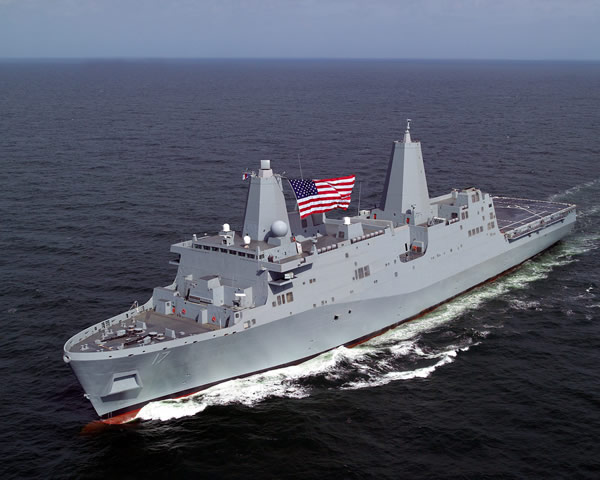
USS San Antonio LPD17 (Source: US Navy)
The HamptonRoads.com article titled "Problems on new ship a bad sign, analyst warns" states:
The ''poor construction and craftsmanship'' Navy inspectors say they found last month aboard a new amphibious ship could be an ominous sign for the service and the U.S. shipbuilding industry as they embark on a host of other ship programs, a veteran naval analyst warned Wednesday.
Additionally there's this statement:
Inspectors said they found such deficiencies as hazardous wiring, uninstalled ventilation and a crash-prone engineering control system. Though the Navy expects to take possession of the ship in August, the inspectors said the San Antonio is not ready for its crew to come aboard.
That's troubling, the ship is not ready for the crew to come aboard? I know what they really mean is become operational, she's already manned, but the Navy has a problem here and it sounds like another poorly run program and problems with the Shipbuilder.
Joseph F. Yurso a former commander of the Portsmouth Naval Shipyard in Kittery, Maine is quoted in the above article as saying "A nuclear-powered submarine or aircraft carrier receiving its first exam from the Board of Inspection and Survey generally gets fairly high marks". But then goes on to argue that amphibious ships always seem to be at the end of a food chain. What I can't understand is the price tag, $1.2 Billion for a conventionally powered (diesel) ship that looks like a big sub tender, how is that the end of the food chain?
But Mr. Yurso brings up a good point, at least in recent history, that new class submarine programs seem to have the good record. In contrast take progress of the new Virginia Class SSN as reported in The New London Day back in June:
The Groton-based USS Virginia could deploy later this year, more than a year ahead of what would be a typical schedule, becoming the first nuclear submarine to go on an official mission before a year of testing and a year of repair, top Navy officials said this week.
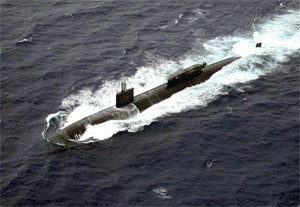
Virginia Class Submarine (Source: US Navy)
A few of my fellow bubbleheads have commented on the USS Virginia's program success back then, such as here and here as well as comparing the Virginia class to the DDX program here or the LCS program here.
This former EB yardbird and Submariner may be a little bias but I think the submarines are money well spent in comparison to some of the Navy's new surface ship classes.
Saturday, July 16, 2005
"I am become death the destroyer of worlds."
60 years ago today J. Robert Oppenheimer recalled a passage from the Bhagavad-Gita: "I am become death the destroyer of worlds".
July 16, 1945 at 5:29:45 am local time saw the first test detonation of an Atom Bomb.
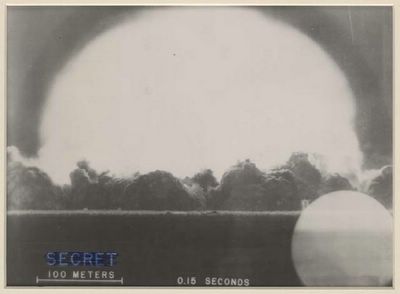
First Atomic Test (Source: DOE)
Today there stands a marker at ground zero of the Trinity Test site.
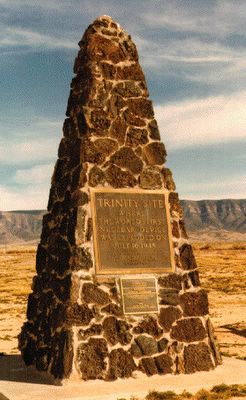
Trinity Site Marker (Source: White Sands Missile Range- US Army)
If your interested in the history behind the Trinity Site the White Sands Missile Range has an extensive website on the site's past and present history. Here's an excerpt about the current radiation levels at ground zero:
Radiation levels in the fenced, ground zero area are low. On an average the levels are only 10 times greater than the region's natural background radiation. A one-hour visit to the inner fenced area will result in a whole body exposure of one-half to one millirem.
In addition to over 80 photos and eye witness accounts the website provides information on the White Sands Missile Range open house at the Trinity Site. The open house started today on the 60th anniversary.
If your also interested in the history on the Manhattan Project the DOE has an interactive website as well.
The first Soviet atomic bomb test took place in August, 1949 four years after the Trinity Test. The Cold War and Nuclear Arms race had begun and didn't end until the collapse of the Soviet Union in 1991.
July 16, 1945 at 5:29:45 am local time saw the first test detonation of an Atom Bomb.

First Atomic Test (Source: DOE)
Today there stands a marker at ground zero of the Trinity Test site.

Trinity Site Marker (Source: White Sands Missile Range- US Army)
If your interested in the history behind the Trinity Site the White Sands Missile Range has an extensive website on the site's past and present history. Here's an excerpt about the current radiation levels at ground zero:
Radiation levels in the fenced, ground zero area are low. On an average the levels are only 10 times greater than the region's natural background radiation. A one-hour visit to the inner fenced area will result in a whole body exposure of one-half to one millirem.
In addition to over 80 photos and eye witness accounts the website provides information on the White Sands Missile Range open house at the Trinity Site. The open house started today on the 60th anniversary.
If your also interested in the history on the Manhattan Project the DOE has an interactive website as well.
The first Soviet atomic bomb test took place in August, 1949 four years after the Trinity Test. The Cold War and Nuclear Arms race had begun and didn't end until the collapse of the Soviet Union in 1991.
Tuesday, July 12, 2005
Previous Shuttle Launches – A Submariner’s Perspective
One of the rare treats this former SSBN boomer sailor experienced was to watch a Space Shuttle launch from the pier at PCAN (Port Canaveral). In 1985-86 the USS Alabama SSBN 731 had just finished our post construction and shipyard evolutions. We had done all our workups, shakedowns, DASOs and were ready to go on patrol. During one of our last AUTEC visits we did a port call at PCAN, one of the few places where an 16,764 surface tons 38’ draft Trident submarine can go.
What I got to witness was, what I seem to recall, the last Shuttle launch before the Challenger disaster. STS-61C Shuttle launch #24 occurred at 6:55 am on January 12, 1986. Our Commanding Officer had us all go topside to the pier for our morning muster. After the division heads and COB had reported to the CO that all was present and accounted for (liberty in Cocoa Beach can be a little distracting) the crew waited silently.
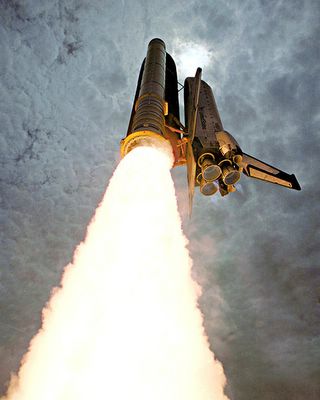
Shuttle Launch (Source: NASA)
The calm of that cool January morning changed dramatically when the dim light of dawn became much brighter and the morning quiet was interrupted with the characteristic low frequency rumble of the Shuttle Columbia's engines and boosters lighting off. What an awesome event to experience, you could feel the sound in our bones. But within minutes all was back to normal, the only evidence being a slowly dissipating contrail path of the Shuttle’s trajectory. The Columbia had a successful 6 day mission landing at Edwards Air Force base on January 18 1986.
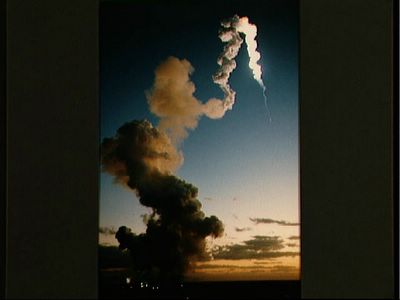
STS61C Launch (Source: NASA)
About a month later, with the experience of watching a Space Shuttle launch fresh in my mind , I was on the Alabama doing a submerged transit through the Straits of Florida. We were on our way to the west coast and the Bangor Submarine Base WA via a goodwill PR visit to our namesake state and the City of Mobile when we got the news. I had just hit the rack when the CO comes on the 1MC with the news of the Challenger’s explosion. The obligatory moment of silence somehow didn’t seem adequate. Years later the Shuttle Columbia, that I watched liftoff in 1986, was also lost on its 2003 STS-107 mission deorbit.
I may be projecting here but I think submariners feel a distant kinship to astronauts. We both operate some of the most complex machines built by mankind. We work in inhospitable environments where a mistake can cost you and your shipmates their lives. In a recent generation both have lost some of their finest Challenger and Columbia; Thresher and Scorpion.
Throughout these tragedies, our country has risen to the greater challenge. We have found men and women willing to take the risks in the vacuum of space or the pressure of the deep ocean.

Apollo 11 Launch 1969 (Source: NASA)
Today 7/13/05 NASA is ready for the challenge again and return to flight. I would love to be at PCAN again to watch this next Shuttle launch. In any case I'll be watching on TV and wishing the crew of the Shuttle Discovery and mission STS-114 gods speed and a successful mission.
What I got to witness was, what I seem to recall, the last Shuttle launch before the Challenger disaster. STS-61C Shuttle launch #24 occurred at 6:55 am on January 12, 1986. Our Commanding Officer had us all go topside to the pier for our morning muster. After the division heads and COB had reported to the CO that all was present and accounted for (liberty in Cocoa Beach can be a little distracting) the crew waited silently.

Shuttle Launch (Source: NASA)
The calm of that cool January morning changed dramatically when the dim light of dawn became much brighter and the morning quiet was interrupted with the characteristic low frequency rumble of the Shuttle Columbia's engines and boosters lighting off. What an awesome event to experience, you could feel the sound in our bones. But within minutes all was back to normal, the only evidence being a slowly dissipating contrail path of the Shuttle’s trajectory. The Columbia had a successful 6 day mission landing at Edwards Air Force base on January 18 1986.
046.jpg)
STS61C Launch (Source: NASA)
About a month later, with the experience of watching a Space Shuttle launch fresh in my mind , I was on the Alabama doing a submerged transit through the Straits of Florida. We were on our way to the west coast and the Bangor Submarine Base WA via a goodwill PR visit to our namesake state and the City of Mobile when we got the news. I had just hit the rack when the CO comes on the 1MC with the news of the Challenger’s explosion. The obligatory moment of silence somehow didn’t seem adequate. Years later the Shuttle Columbia, that I watched liftoff in 1986, was also lost on its 2003 STS-107 mission deorbit.
I may be projecting here but I think submariners feel a distant kinship to astronauts. We both operate some of the most complex machines built by mankind. We work in inhospitable environments where a mistake can cost you and your shipmates their lives. In a recent generation both have lost some of their finest Challenger and Columbia; Thresher and Scorpion.
Throughout these tragedies, our country has risen to the greater challenge. We have found men and women willing to take the risks in the vacuum of space or the pressure of the deep ocean.

Apollo 11 Launch 1969 (Source: NASA)
Today 7/13/05 NASA is ready for the challenge again and return to flight. I would love to be at PCAN again to watch this next Shuttle launch. In any case I'll be watching on TV and wishing the crew of the Shuttle Discovery and mission STS-114 gods speed and a successful mission.
Saturday, July 09, 2005
SOSUS vigilance from the Cold War to Terrorism
The Sound Surveillance System (SOSUS) was a critical component of the US Navy’s intelligence capabilities during the Cold War. The function of SOSUS during that time was to identify and track the estimated 700 submarines produced by the Soviets. The SOSUS system used the unique propulsion plant acoustic signature produced by a Submarine for its identification and tracking.

First Atlantic SOSUS Stations (Graphic: US Navy Undersea Warfare Magazine)
Since the close of the Cold War the national security role of the SOSUS system has diminished and it has been utilized for more marine environment research applications. But the national security role of SOSUS may be expanded again, this time in response to the terrorist threat and our vulnerability to an attack via a merchant ship. According to this recent Sea Power Magazine article:
The Navy and other U.S. government agencies intend to identify and track the world’s 121,000 merchant vessels with the same persistence and precision that characterized the Navy’s location, identification and tracking of Soviet submarines during the Cold War era.
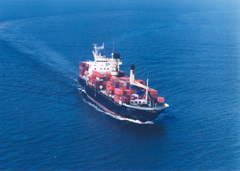
Container Ship (Source: NOAA)
SOSUS will become part of a larger integrated data collection system to track and provide real time identification of merchant ships. Additional components of this intelligence data collection system would include space-based surveillance, an existing maritime Automatic Identification System (AIS) and newly developed Advanced Deployable Systems (ADS).
SOSUS will be expanded and upgraded so that acoustic surveillance of ports and littoral areas can be included. These littoral areas have high ambient noise levels that make it difficult to conduct acoustic surveillance.
A comprehensive system to track merchant shipping is one method that could help prevent a large scale sea-based terrorism event. In this link "Terror at Sea the Maritime Threat" author Ophir Falk documents how terrorist groups such as Al Qalda not only have been a threat to shipping but may turn to using vessels carrying hazardous materials as terrorist weapons. For example from the article:
The recent appointment of Saud Hamid al-Utaibi as new al-Qaida commander in Saudi Arabia-largely thanks to his expertise in marine terror-has caused many security experts to raise the threat level to maritime security. Hamid al-Utaibi's experience includes an active role in blowing up the USS Cole in October 2000 and in attacking the French Limburg tanker two years later-both rammed by exploding speedboats in Yemeni waters. Subsequent to the appointment, the United States warned a number of Mediterranean states that maritime attacks involving chemical agents might be imminent.
Of additional concern is what could be called "the poor man's missile platform". States that sponsor terrorist activities such as Iran have recently experimented with outfitting merchant vessels with Scud missiles. It was also widely reported in 2003 that Al Qaeda may also have a navy of sorts consisting of fishing boats and cargo vessels.
The integration of all this data from so many sources seems like a monumental task, but a task worth doing. I can see additional benefits as well as increasing port security, such as providing information for use in the Proliferation Security Initiative, help in locating lost or missing ships in emergencies as well as knowing where all the good targets are if things ever get hot. But I wonder how a operational conversation would be if SOSUS starts tracking all the merchant ship traffic. Will the sonar operator's report be "Duty Officer I hold Sierra 119,991 leaving Doha, Qatar course 045, speed 12 knots, range... ah hell what do I care we're in Virginia" ?
First Atlantic SOSUS Stations (Graphic: US Navy Undersea Warfare Magazine)
Since the close of the Cold War the national security role of the SOSUS system has diminished and it has been utilized for more marine environment research applications. But the national security role of SOSUS may be expanded again, this time in response to the terrorist threat and our vulnerability to an attack via a merchant ship. According to this recent Sea Power Magazine article:
The Navy and other U.S. government agencies intend to identify and track the world’s 121,000 merchant vessels with the same persistence and precision that characterized the Navy’s location, identification and tracking of Soviet submarines during the Cold War era.
Container Ship (Source: NOAA)
SOSUS will become part of a larger integrated data collection system to track and provide real time identification of merchant ships. Additional components of this intelligence data collection system would include space-based surveillance, an existing maritime Automatic Identification System (AIS) and newly developed Advanced Deployable Systems (ADS).
SOSUS will be expanded and upgraded so that acoustic surveillance of ports and littoral areas can be included. These littoral areas have high ambient noise levels that make it difficult to conduct acoustic surveillance.
A comprehensive system to track merchant shipping is one method that could help prevent a large scale sea-based terrorism event. In this link "Terror at Sea the Maritime Threat" author Ophir Falk documents how terrorist groups such as Al Qalda not only have been a threat to shipping but may turn to using vessels carrying hazardous materials as terrorist weapons. For example from the article:
The recent appointment of Saud Hamid al-Utaibi as new al-Qaida commander in Saudi Arabia-largely thanks to his expertise in marine terror-has caused many security experts to raise the threat level to maritime security. Hamid al-Utaibi's experience includes an active role in blowing up the USS Cole in October 2000 and in attacking the French Limburg tanker two years later-both rammed by exploding speedboats in Yemeni waters. Subsequent to the appointment, the United States warned a number of Mediterranean states that maritime attacks involving chemical agents might be imminent.
Of additional concern is what could be called "the poor man's missile platform". States that sponsor terrorist activities such as Iran have recently experimented with outfitting merchant vessels with Scud missiles. It was also widely reported in 2003 that Al Qaeda may also have a navy of sorts consisting of fishing boats and cargo vessels.
The integration of all this data from so many sources seems like a monumental task, but a task worth doing. I can see additional benefits as well as increasing port security, such as providing information for use in the Proliferation Security Initiative, help in locating lost or missing ships in emergencies as well as knowing where all the good targets are if things ever get hot. But I wonder how a operational conversation would be if SOSUS starts tracking all the merchant ship traffic. Will the sonar operator's report be "Duty Officer I hold Sierra 119,991 leaving Doha, Qatar course 045, speed 12 knots, range... ah hell what do I care we're in Virginia" ?
Subscribe to:
Posts (Atom)