Sunday, November 27, 2005

Rigging for Quite

I 'll be traveling on business this week so the blog will be quite with no posting for about that time.

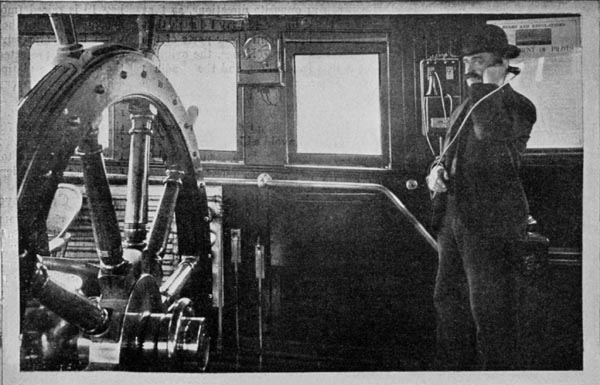
Speaking of sound and silence, is the photo below of the first Sonarmen in training?

Fessenden Submarine Oscillator (Source: NOAA)

In 1914 the Fessenden Oscillator was invented by Dr. Reginald Fessenden of the Submarine Signal Company in order to communicate between ships and between ships and shore facilities. The above photo is demonstrating a listening device, very similar to a telephone, used on board ships as part of Dr. Fessenden's system.

Additionally if your interested in doing some sonar watchstanding check out the following quick google of links:

NOAA Vents program Acoustic Monitoring.

Whale Acoustics research company's ocean sounds page.

J & A Enterprises, Inc. Noise and Vibration Control Engineers ocean sounds page.

And a large historical collection at the HNSA-Historic Naval Sound and Video webpage.

Finally a bit of computer geek trivia on the PING command, who knew it had anything to do with sonar.

Back in a week. -LL

Wednesday, November 23, 2005

Israel's MAD Dolphins

According to news reports the Germans are going ahead with plans to sell Israel two new AIP-equipped Dolphin class SSK submarines. Israel already owns three Dolphin submarines acquired from Germany in a deal made after the first gulf war. These Dolphin subs replaced Israel's German built Gal Class submarines, which entered service in 1977.

The Dolphin class is designed for interdiction, surveillance and special-forces operations with torpedo and cruise missile weapons capabilities.

Dolphin Class Submarine

Specifications
Crew - 30 - 35
Displacement, surfaced - 1,640 tons surfaced , 1,720-1900 [est] submerged
Length - 57.3 m (188ft)
Beam - 6.8 m (22.6ft)
Dived speed - 20 knots
Operating Depth - Deeper than 200m (600 feet)
Cruise Range - 8,000 miles surfaced, 400 miles submerged
Weapons capacity - 16 surface to surface missiles or torpedoes
Sensors - PRS-3 passive ranging sonar, kollmorgen periscopes
Propulsion - three 16v mtu 396 se 84 diesel engines, single screw.

These new Dolphin submarines will be equipped with an air-independent propulsion (AIP) system not on Israel's current submarine inventory. This system would significantly increase the subs submerged range and stealth.

It is rumored that Israel in 2002 off Sri Lanka tested a nuclear-capable version of the Popeye Turbo cruise missile from one of it's Dolphin Class submarines. This Submarine Launched Cruise Missile (SLCM) reported range was about 1,500 km, significantly larger then any other SLCM variant carried by Israeli subs.

The rumours concerning Israel's nuclear-capable cruise missiles had stalled these additional sales from Germany in 2003, as did Israeli reluctance over the price. The current deal is reported to be worth EUR 1 billion ($1.17 billion) for the two AIP-equipped SSK Dolphin Class submarines.

The $1.17 billion acquisition of these submarines constitutes a major outlay from the Israeli defense budget which was about $9.1 billion in 2003.

Why should Israel acquire modern SSKs?

One reason is the rise of terrorist organizations using sea piracy as a means of income and economic intimidation. The North Africa region around Somalia has seen recent pirate activity. Additionally the sea has been an avenue for terrorist attacks in Israel.

Three Middle Eastern countries also operate submarines in the region; Egypt, Pakistan and Iran of which Iran's government continues to be openly threatening to Israel.

It's easy to speculate that with Iran's nuclear ambitions, stone walling of UN and EU nuclear inspections and continued support of terrorism, Germany has made a strategic decision here by going forward with the once stalled purchase. By providing Israel a weapons delivery platform that could provide a nuclear second strike capability they could be brokering a Middle East version of the old cold war MAD mutual assured destruction stalemate. This could also be seen as a way of putting pressure on Iran to cooperate with the IAEA.

Israel Map (Source CIA Fact Sheet)

The main Israeli submarine flotilla is based at the Mediterranean seaport of Haifa, but there is a Naval installation in the port of Eilat on the Red Sea. Eilat Naval base with it's Red Sea access would allow Israeli submarines to operate in the volatile Indian Ocean and Persian Gulf areas. The Eilat Naval Base is where the "Karine A" weapon smuggling freighter was taken after it was seized in January 3, 2002 by Israeli special forces.

If the news reports are correct and Israel does have nuclear weapons, it looks as though a sea based nuclear deterrent force is in the making.

Sunday, November 20, 2005

From Gettysburg to Fallujah – The Principles of Freedom

Yesterday was the anniversary of Abraham Lincoln’s Nov. 19, 1863 Gettysburg Address. In reading Lincoln’s words, I could not help but think of the principles and sacrifice he described in the context of today’s war on terrorism. Lincoln wrote the Gettysburg Address at a low point in the civil war and after one of it’s worst battles, claiming 45,000 casualties of which approximately 7,000 were killed in action.

Please clear you head of all those old political arguments, either for or against the war in Iraq, and think of broader principles of freedom in the Middle East and the sacrifices of those fighting for that freedom as you read Lincoln’s words:

“Fourscore and seven years ago our fathers brought forth, upon this continent, a new nation, conceived in liberty and dedicated to the proposition that all men are created equal.
Now we are engaged in a great civil war, testing whether that nation, or any nation so conceived and so dedicated, can long endure. We are met on a great battlefield of that war. We have come to dedicate a portion of it, as a final resting place for those who died here, that the nation might live. This we may, in all propriety do. But in a larger sense, we cannot dedicate, we cannot consecrate, we cannot hallow, this ground. The brave men, living and dead, who struggled here, have hallowed it, far above our poor power to add or detract. The world will little note, nor long remember what we say here; while it can never forget what they did here.


It is rather for us the living, we here be dedicated to the great task remaining before us--that from these honored dead we take increased devotion to that cause for which they here gave the last full measure of devotion--that we here highly resolve that these dead shall not have died in vain, that this nation shall have a new birth of freedom, and that government of the people, by the people, for the people shall not perish from the earth."

Audio link to the Gettysburg Address read by actor Jeff Daniels.

I think the last paragraph in Lincoln’s address is an appropriate juxtaposing to Iraq in that we owe those who "gave the last full measure of devotion--that we here highly resolve that these dead shall not have died in vain, that this nation shall have a new birth of freedom".

Gettysburg is a quite place today because of those who sacrificed for freedom in Lincoln's time, and Fallujah, read what Greyhawk at The Mudville Gazette recently posted about progress in that city from a year ago.

Friday, November 18, 2005

Millblog Link to a Stg. in Iraq letter - Taste of Freedom

Visit Stg. Hooks site and read a 101st Airborne Division soldier's letter "Taste Of Freedom" to the people back home.

Puzzling Submarine Location

Got time to kill? Assemble this submarine puzzle and let me know, in the comments, where the photo was taken .

Click on the link, let the puzzle load, click and drag the pieces, start with the corners and then the sides.

Have fun and remember, putting a puzzle together doesn't have to be a race!

Update: OK, if you don't have the time here's the J.O. version it's easier.

Puzzle Location Solved: USS Providence (SSN719) inbound to NLON past Ledge Light.

Thursday, November 17, 2005

ASDS program afloat or sinking?

Are we in for a political food fight over the Advanced SEAL Delivery System (ASDS) program?

The answer may be yes, U.S Rep. Rob Simmons (R) of CT. say the ASDS program, under its current prime contractor Northrop Grumman, is 600 percent over budget and four years behind schedule. Simmons, who's district includes Groton CT home of the Electric Boat Company, has said the entire $1.2 billion program should be re-bid (Article in The Day registration required).

According to Simmons, Electric Boat's use of new production technologies in the Seawolf and Virginia class programs demonstrates the company's ability to develop advanced submarine systems and therefore should be considered as a possible contractor in any re-bid. As a member of the House Armed Services Committee Rep. Simmons has influence over such recommendations to the Navy and is pushing such a proposal publicly.

Advanced Seal Delivery System (Source: US Navy)

But not so fast, Democratic Sen. Barbara Mikulski of Maryland, says she has already won the fight to fully fund the program at $147.5 million for fiscal 2006. Ms. Mikulski serves on the Senate Appropriations Subcommittee on Defense. Reuters is also reporting that the prime contractor Northrop Grumman Corp. is upbeat on the Navy's ASDS mini-sub program.

Sen. Mikulski's district includes the Northrop Grumman's Bay Bridge plant in Annapolis where the ASDS is being developed. The plant could stand to get 150 new jobs if the $148 million contract is approved within the current spending package.

Ms. Mikulski has been appointed to a conference committee where the House and Senate will hash out differences in the bill before it goes to President Bush's desk.

Northrop Grumman hasn't had a good track record recently as I've noted here with submarines and here with surface ships.

It will be interesting to see if Rep. Simmons (R CT) can make a convincing enough argument to take the contract away from a defense contractor and a Senator with more political clout than budget sense.

Wednesday, November 16, 2005

A Diggit with Onions

I love good satire, here's one from our friends at - The Onion.

"Life In The Navy Rocks Even Harder Than The Commercial Implied"

Man, skimmers white hats really have cool jobs. All we did on Boomer subs was field day and run WSRT and SCAM drills. Then again, us bubbleheads did get some occasional background music played by some Senior Chief pickin he's teeth.

Monday, November 14, 2005

Singapore's Submarines

The Republic of Singapore is a small island nation of about 263 Square miles or a little more than 3.5 times the size of Washington DC. It has a population of about 4.4 million, a parliamentary republic style government and a strong free market economy. Most countries of this size have a limited Navy and usually no submarine force. But Singapore does have a relatively large Navy and a submarine force of four RSS Challenger class coastal submarines.

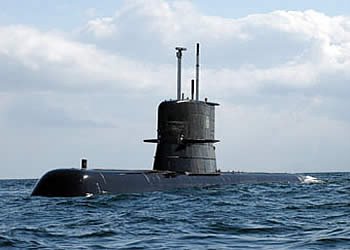
Singapore has recently signed a contract to purchase two SSK Vastergotland-class submarines from the Royal Swedish Navy with the Swedish shipbuilder Kockums AB modernizing the subs and making modifications for operation in tropical waters. These two submarines are likely to replace two of the older Challenger submarines. In service date after modification is expected to be before 2010.

Vastergotland Class Submarine

Why does country as small as Singapore need modern SSK submarines?

Both of Singapore's neighbors have submarines or plans to purchase SSKs, Indonesia has two Cakra-class Type 209 subs and Malaysia has planned to purchase two Scorpene SSKs. But the real reason is that Singapore sits at the bottom of the Malacca Strait the single biggest chokepoint in the far east for shipping traffic including oil shipments to the energy hungry industrial economies of China, Taiwan, Japan and Korea. The Phillips Channel near Singapore is only 1.5 nautical miles (2.8 km) wide at its narrowest point. Singapore's economy is dependent on this shipping with exports of an estimated $174 billion in 2004. The country's merchant marine consists of 923 ships ranging in type from bulk carriers and container ships to petroleum and LNG tankers.

The Malacca Strait has been a hotbed of piracy and Indonesia, bordering the strait, has seen Al-Qaida sponsored terrorism. These two factors also contribute to Singapore's determination to keep a strong and modern naval presence (including submarines) in the Malacca Straits. This relationship between piracy and terrorism has also prompted Lloyd's of London to treat the threat of piracy as a war risk and subsequently change its rates.

When it comes to intelligence gathering on pirate activities, there is a question on whether submarines could be a political liability in the Malacca Strait. Because all Southeast Asian nations would have to be in agreement on the use of submarines the advantage a submarine may have in it's stealth could be compromised by agreements regarding operating restrictions. Most pirates are operating out of sheltered coastal coves, a foreign submarine continually operating in a disputed territory could touch a nerve between neighboring countries.

After reading this post and comments over at Chapomatic started by commissar post at The Politburo Diktat I thought it an interesting correlation between Singapore's recent submarine purchase, it's neighbors similar ambitions and the problem of Terrorism and Piracy in the Malacca Straits.

Submarines may not be the complete answer against pirates in the Malacca Straits or the Horn of Africa but they sure could take out a terrorist mothership if needed.

Thursday, November 10, 2005

1981 – Was My Waiter a Spy?

Security and Spies seems to be a theme in my last couple of posts so I’ll continue with this line and add a sea story (personal experience) and confession to the mix.

In the fall of 1981 on my first FBM patrol aboard the USS Simon Bolivar SSBN641(G), we had an equipment causality that necessitated us pulling into port for repair. That port was Bridgetown Barbados, not a bad place to make a liberty call. On the last day in port, a group of us went to a hotel on Paradise Beach. They had a nice bar on the beach and it seemed to be the place to relax, enjoy some reggae music and drink Banks beer.

About four of us were sitting at a table just off the beach within sight of the bar. We had a few rounds before finding out that the band wasn’t going to start for an hour or so. My shipmates were getting board and had decided to take a walk down the beach to check out the bikini scenery. Being the submarine non-qual and lightweight drinker of the group, I stayed behind to finish my beer.

The friendly waiter who had been serving us that afternoon was going off shift and stopped to see if my friends were returning and if I needed anything. Then he struck up what was at first an innocent conversation. I recall it went something like this:

Waiter – “Are you from the submarine over there in the harbor?” pointing in the direction of Bridgetown.

LL – “Yes, we’ve been in port a few days for a liberty call.”

Waiter – Sits down across from me “I’ve traveled on ships but I’d like to know what it’s like being on a submarine, how long do you stay at sea?” expressing what appeared to be a general curiosity.

LL – “This is my first time at sea; we’re supposed to do around 70 days a patrol.”

Waiter – After a few are fairly long general questions he picks up the pace, “If someone gets sick, do you have a doctor on board?”, “What’s the food like?”

LL – The questions he’s asking seem to be harmless enough so I answered the best I could for someone new to submarines. “We have a corpsman to handle emergencies.”, “The food is good but you run out of fresh milk and produce about two weeks out.”

Waiter – The next two questions came fast and without pause “You’re a missile submarine do you carry the Poseidon or Trident C4?”, “What is the range of the C4 missile?”

LL – Even with a few beers in me, this stopped me in my tracks. To the first question about the type of missile we carried, I just looked at him and didn’t say anything. On the second question about the C4 Missile range, I shook my head “NO” and did not say another word.

My “friend” the waiter looked upset with my non-answer and quickly left without saying anything. Just then, my shipmates returned no longer board after a successful bikini-scouting mission.

I don’t know if I just didn’t recognize what had just happened or being new to the real Navy felt too scared to relate my five-minute conversation with a waiter to the duty officer, but I never reported it. In either case, I should have reported what had occurred.

I relate this story as a sort of lesson leaned because if that waiter was an intelligence agent I could have made a serious mistake in not reporting my unease with what had happened. I didn’t disclose classified information but, if the waiter was an agent, by reporting the incident, I could have compromised his status.

Lesser Antillies (Source: NASA)

You see that was late in 1981 and Barbados is in close proximity to Grenada. After President Reagan's 1982 visit to Barbados, he voiced a fear that Grenada, with its socialist government and proximity to Cuba, could become a Communist beachhead in the Caribbean. In October of 1983 Operation Urgent Fury was launched, after a request by the Organisation of Eastern Caribbean States (OECS), to stop the bloody seizure of power by a hard-line Marxist group in Grenada. It was believed that the Cubans were behind a government coup in Grenada and their agents had been operating for years on the islands around Grenada. Barbados was one of the island nations with great concerns about it’s neighbor's political direction.

Maybe my waiter was a spy maybe he wasn’t, but I wasn’t the one to make that determination. In any case if you’re active duty and someone is asking you questions that start off innocent but become progressively closer to what should remain unsaid be wary and let your command know of your suspicions.

Some things that seem simple or inconsequential at the time could actually mean something later on, you never know.

Sunday, November 06, 2005

Chinese Spies - Damn they're everywhere!

If you thought the old cold war Soviet KGB was the "last" big human intelligence (HUMINT) network in the world, you're sadly mistaken. The Chinese have been big into HUMINT "Spying" and continue to be in a major way. Evidence the recent arrests in Los Angeles of a Chinese intelligence-gathering ring. (hat tip: MT1(SS)). Of particular interest is that fact that the Chinese spies were caught with classified information on the new Virginia class submarine. Two blogs on my "Submariner Blogroll", have posts up on this news; Gus Van Horn here and Chapomatic here.

Chinese spies have been very active of late, lets do a little news run down:

Belgium and Greater Europe - The Telegraph, China aims spy network at trade secrets in Europe.

Canada - CBC news, Defectors say China running 1,000 spies in Canada.

Japan - The China Post, Who's spying now?

Russia - The Daily Telegraph, Official charged with spying for Beijing.

Sweden - The Local, China "suspected of spying at Swedish universities".

United States - Strategy Page, The FBI and the Chinese Spy Army.

Via the Internet 1 - NetworkWorld.com, Communist China spying via the ‘Net?

Via the Internet 2 - Australian IT, Worms do China's spying.

Via the Internet 3 - Washington Post, Hackers Attack Via Chinese Web Sites .

How difficult is it to track a Chinese national if they were involved in espionage?

According to the FBI and U.S. Immigration, cultural and economic exchange between the United States and China results in about 150,000 Chinese students studying at U.S. Universities and about 700,000 Chinese tourists and business executives visiting the U.S. each year.

China may be a valued trading partner but they don't have our interests in mind, in fact, much to the contrary.

The Media Line - IRAN LAUNCHES FIRST SPY SATELLITE (Chinese-made satellite)

Persian Journal - The Chinese Communist Party Won Iran's "Election".

The Washington Post - China Tells Congress To Back Off Businesses.

The Washington Times - China may attack Taiwan in two years: Pentagon.

Science Daily - Chavez may sell F-16 planes to China, Cuba.

The Heritage Foundation - Balancing China's Growing Influence in Latin America.

Everyone spy's, but with this much activity being reported in the press it's got me wondering, are the Chinese bad at the espionage business or is their operation so large that they can afford to have a few get caught? I'm thinking the latter....

Friday, November 04, 2005

MilBlogging With Open Source Information

There are many bloggers covering the military, some active duty, some retired, some veterans of various campaigns and conflicts. All provide varying degrees of experience and insight into previous and current events. Like journalists, in our open and free society they are exercising their right to free speech, adding to an overall discussion on defense policy and informing their readers on varying topics of interest. Unlike Journalists though the Milblogger does their writing within defined restrictions because of their current or previous service. The Milblogger also knows that if he is negligent or sloppy with his posting a fellow servicemen could be put at risk.

So here's the question:
How difficult is it to prevent writing something that, although open sourced, could compromise the security of what the Milblogger holds dear, their country and service?

Intelligence is more than covertly obtained secrets, more times than not is a mosaic of information pieced together to create a picture of the capability, direction or intent of an adversary. Collecting intelligence into this mosaic can come from a number of places, some covert; satellite imagery, signals/communication intercepts, human intel or overt such as simply reading the news and professional journals "Open Sources".

Open Sourced Intelligence
In a recent CIA unclassified paper by CIA Analyst Stephen C. Mercado titled "Reexamining the Distinction Between Open Information and Secrets" the author argues that open sources often equal or surpass classified information. He also contends that the Intelligence Community (IC) needs to assign greater resources to open source intelligence (OSINT), stating that OSINT’s share of the overall intelligence budget has been estimated at roughly 1 percent but provides anywhere from 35 to 95 percent of the intelligence used in the government.

So are Milbloggers acting as journalists or a disassociated network of OSINT collectors unknowingly aggregating information for an adversary or unfriendly nation?

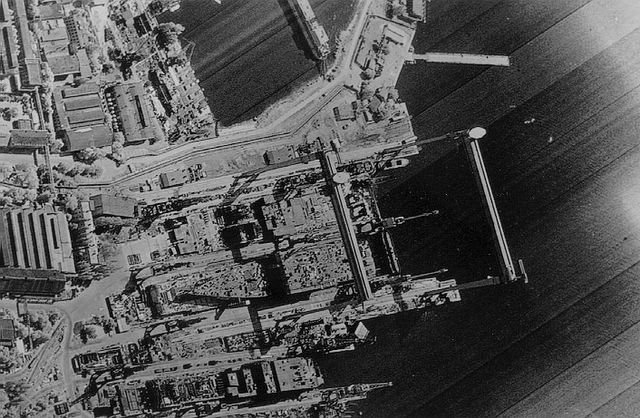
Overt and covert sources of intelligence are sometimes one in the same when leaked information makes it to the public sector. A prime example is the below K-11 spy satellite photo taken 1984 of an under-construction Soviet aircraft carrier. Later in the following year that classified photo appeared in the professional journal Jane's Defence Weekly exposing and therefore compromising a key US overhead imagery intelligence (IMINT) capability.
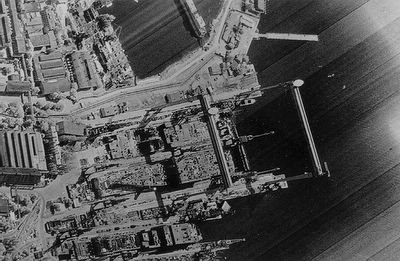
K-11 Spy Satellite Photo of Nikolaiev 444 shipyard in the Black Sea 1984.
(Public Domain Sourced: National Reconnaissance Office via Wikipedia)

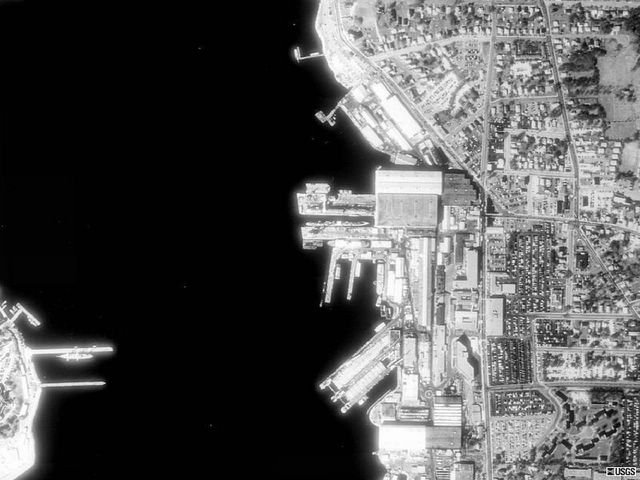
Today I can get open sourced satellite imagery approaching the 1984 K-11 leaked photo. The below image is of Electric Boat shipyard in Groton, CT where submarines are constructed. The terrserver website provides two additional levels of magnification than I posted here.
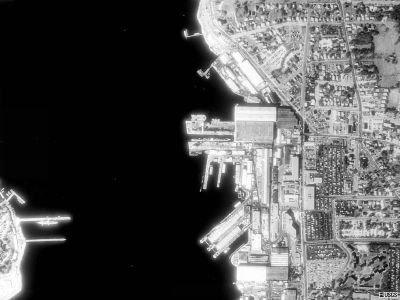
Electric Boat Shipyard- 4/1991 (Open Sourced: USGS via terraserver-usa.com)

If I annotated the above photo with additional information pertinent to a news event at the shipyard am I blogging as a journalist? What if I added some personal, though unclassified, insight into that event. Could I become an OSINT source with this additional and unique information added, probably.

Open Source Value
Mr. Mercado argues the OSINT at times provides a better value than covert intel in terms of speed, quantity, quality, clarity, ease of use, and cost. He sites bloggers as one open source that fits the better value "Open Source" criteria.

The Milblogger has a conflict here for all the things that makes his site worth reading are exactly what makes it a value as a OSINT source. In the zeal to provide interesting content, the Milblogger could cross that fuzzy line of what is of value to a reader who is not friendly. Without knowing exactly what knowledge this unfriendly reader is seeking it's impossible to defend against.

Crossing the Line into Classified Info
For many military personnel serving in Iraq and Afghanistan blogs have become a more efficient way to share the intensity of their experience. But writing about their experiences in a war zone the Milblogger has to be extra careful not to divulge tactics, techniques, system vulnerabilities, operations, methods, etc.

Milblogs have leaked classified information and the military has disciplined some service members. In August 2005, an Arizona National Guardsman on active duty in Baghdad was demoted and fined for publishing classified information on his personal blog.

The Army in particular has seen blogs as a serious "loss lips sink ships" kind of problem.

Conclusion
Aside from being difficult problem, I don't see a clear answer on how to the mitigate the risk posed by open sourced information. Our society’s freedoms are based on the free flow of ideas, apart from clearly defined state secrets; an effective model of self-censorship for Milblogs isn't available. After all even without Milblogs most of the information is open to the public, just not assembled in one place and easy to find.

Of course, other countries are far less tolerant of blogs, even one that covers a topic that has nothing to do with the military.

Update 11/9/05 22:00 : As a prime example of exercising discretion in what you post and being diligent in preventing the inadvertent disclosure of sensitive information, MT1(SS) over at Four Knots to Nowhere seems to have caught a breach. He's reporting the sensitive info is already down from the offending site. Bravo Zulu!
Sunday, October 30, 2005

More Virginia Class Design and Concept Info

I can't help but add to what Bubblehead and Vigilis have posted on the USS Virginia (SSN 774) here and here .

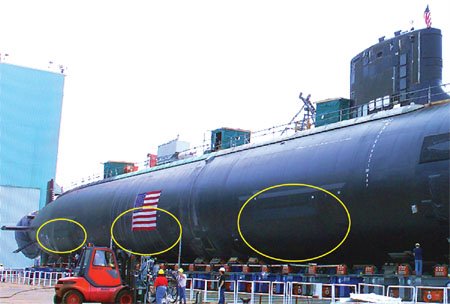
The below photo of the Virginia during construction has three holes circled where a new fiber optic Lightweight Wide Aperture Array (LWAA) is to go.

USS Virginia (Source: US Navy - NRL)

The system is the first fiber optic surveillance grade acoustic sensor system on an operational platform. Information can be found on the system's development from 1980's to production in 2000 at the Office of Naval Research, Naval Research Laboratory Review 2004 - "Development of the Fiber Optic Wide Aperture Array: From Initial Development to Production". Six sonar arrays three per side composed of Lasers and Fiber Optics translates to high bandwidth, I would think.

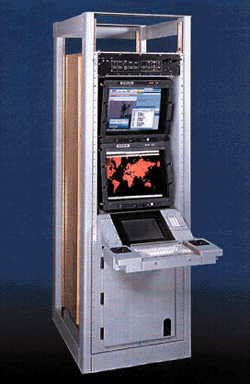
For a taste of how some of the consoles may function and integrate with other systems, I found this article from Undersea Warfare Magazine Fall of 2000 on the USS Virginia's Onboard Team Trainer Master Controller (OBTT MC).

OBTT Prototype (Source: US Navy)

The onboard simulation system will be capable of supporting a whole host of contacts including up to:

• 10 Medium Frequency Active (MFA) and Passive Sonar Contacts.
• 20 High Frequency Active (HFA) Sonar Contacts.
• 20 Tactical Weapon Simulator (TWS) Contacts.
• 35 Imaging Contacts (Visual/Infrared).
• 128 ESM Contacts.
• 10 Radar Contacts, and
• 8 stored harbor models for ingress and egress training.

The system will also interface with the ships Communication suite simulating Over-the-Horizon/Global Command and Control System-Maritime (OTH/GCCS-M) communications.

The system uses of Commercial-off-the-Shelf (COTS) components to conduct onboard and at-sea simulated engagements comparable to those of a shore-based team trainer.

Conceptual info Video Links:

I did find some cool broadband streaming video over at the Lockheed Martin video gallery covering some of the concepts incorporated or proposed for the Virginia class submarine.

The first concept is leveraging Commercial-off-the-Shelf (COTS) components to increase adaptability and processing power. Link "Always the Leader"(5.53 MB .WMV)

Next is the idea of optimizing for a time sensitive target strike through a system called "Transformational Tactical Targeting". Key component of the concept is the GCCS-M mentioned above. Link "T3" (9.57 MB .WMV)

Finally the "Sea Talon" Submarine launched UUV for littoral areas. Link "Sea Talon" (9.19 MB .WMV)

Although none of video is of the interior of a Virginia class sub they do provide a look into some of the concepts incorporated in that class of submarine. I also have to say Lockheed Martin has a slick marketing department, lots of cool stock submarine footage and a forceful narration to put their concepts and products forward.

Saturday, October 29, 2005

Post Brac Mini-Boom at PNS

Just a short note, If you followed the Brac commission base closure deliberations over summer as I did, at one point you probably thought that Portsmouth Naval Shipyard (PNS) was surely going to get the axe and close. Reasoning old facility, not enough overhaul work, excess capacity and so on.

Well apparently, PNS is undergoing a mini-boom in jobs, from the New Hampshire Union Leader:

Shipyard commander Capt. Jonathan Iverson said the current work force must grow by 300 people a year to be able to handle the submarine overhaul and maintenance projects that are scheduled.

“For the next four years, we’re chock-a-block full of work,” he said. “With the increased workload, we’re looking to bring more people on.”

Looks like Brac made the right decision in keeping PNS open.

Thursday, October 27, 2005

An Un-Conventionally Armed SSBN

The conventional understanding of a Fleet Ballistic Missile Submarine (SSBN) is that it's sole purpose is one of nuclear deterrence. Loaded with nuclear armed ballistic missiles the Trident SSBN hides with stealth waiting to unleash unthinkable destruction upon any enemy with the nuclear capability to strike the US.

In the October issue of Proceedings magazine author Norman Polmar writes in his article "Strategic Submarine Progress" (not currently available on-line) about some unconventional thinking relating to Submarine Launched Ballistic Missiles or SLBMs.

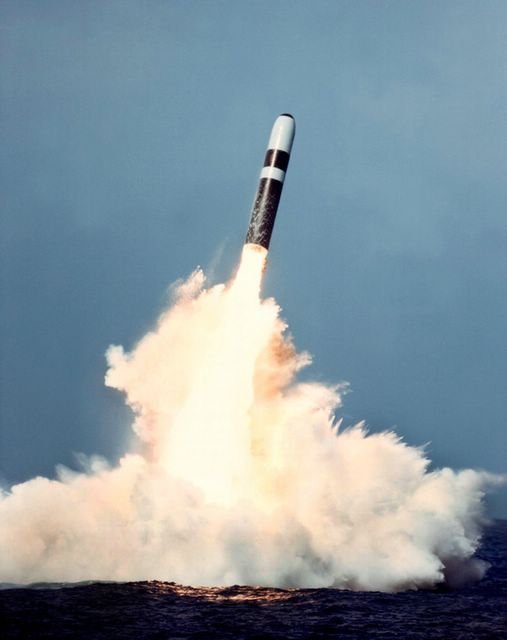
Trident II D5 Missile (Source: US Navy)

The unconventional thinking is put forth by the Defense Science Board and it is to arm some SLBMs with conventional (non-nuclear) warheads. The proposal pertains to the converted Trident SSGNs and recommends retaining some SLBM capacity. Rear Admiral Charles B. Young, Director of Strategic Systems Programs was quoted in Aerospace Daily & Defense Report, 17 June 2005 as saying a SLBM could deliver 1,250 pounds of conventional explosive to a range of 1,500 nautical miles, adding "Time of flight would be about 14 to 15 minutes... So if you have a time-critical target, that is a great capability".

The idea is that a conventional warhead's accuracy could also be enhanced to less than 30 feet with the addition of a global positioning system GPS guidance package. There is also some speculation in Polmar's Proceeding article that if the Navy were to pursue a conventional-warhead Trident missile they may consider arming Trident SSBNs in addition to or instead of SSGNs.

Although I don't think such a proposal would be very cost effective, placing a 1000 lb bomb on a extremely expensive weapons system, it does have its merits. (Addition reading on merits at the Baker Institute in pdf)

First being the ability to place a conventional weapon on a time-critical target from an extreme range. This would give the defense department a quick reaction option to an unanticipated region or situation where other assets could be hours if not days away. The caveat here being that if the target is unanticipated how do you quickly and accurately communicate the targeting information to the submarine submerged and maybe 1500 nautical miles away.

A second benefit could be the shock and awe factor. A dictator or terrorist may feel the remoteness of his location or no clear nearby US military presents as a form of safety until his chemical weapons pilot-plant is destroyed by a warhead falling at something close to Mach in double digits. The kinetic energy release alone could scare the hell out someone standing within visual range. Additionally placing the idea in the head of a dictator that the next warhead could be in the kiloton range may be enough to instill a little behavior modification to the positive.

Third, the capability to deliver a conventional weapon from a great distance with extreme accuracy and within minutes could force hostile nations to either harden or decentralize their high value military assets. The tactic of hardening, hiding or building decentralized redundancy would be costly to a potential enemy and may result in reduced command and control of those assets. The only other option for them would be to build or buy an Anti Ballistic Missile (ABM) system. This could also draw funds and skilled personnel away from the offensive weapons systems that we are more concerned about.

Lastly, the conventional SLBM warhead could be a way of prototyping and testing technology and designs to be later adapted for nuclear warheads. Such technologies could include the aforementioned improved accuracy with GPS as well as bunker busting earth penetrating munitions.

Apart from the cost, numbers of conventionally armed SLBMs would be limited because it would compete with the traditional SSBN role. A SLBM with a conventional warhead would also not be an option where an adversary is a known nuclear power with ICBM and or SLBM capability. A conventional strike could be mistaken for a nuclear one and invoke a nuclear response. Additionally such a weapon would complicate any future arms limitation talks with said powers.

The Navy has rejected this idea in the past but with the advent of the Trident conversions to SSGNs the concept may be given another look.

Video link for Missile one away, Missile two away (mpg 4.1mg).....

Tuesday, October 25, 2005

Toshiba and Russian Espionage – Again

In 1987, the Toshiba Corporation of Japan was accused of illegally selling sophisticated propeller milling machinery to the Soviets through the Norwegian Kongsberg firm. The incident resulted in the arrest and prosecution of two senior executives, as well as the imposition of sanctions on the company by the US and Japan. It also resulted in quieter Soviet submarines principally the Akula Class.

It is also alleged that the
Project 671RTMK Victor III subs incorporated a fully integrated submarine combat direction and fire control command system that ran on computers obtained from the Toshiba Corporation of Japan. This fire control system is said to be based on one developed for the Norwegian Ula class submarines.

So in recent news
here and here, a Japanese employee of Toshiba Corporation has been caught selling confidential data to a Russian official. The leaked data referred to semiconductor technologies that could be used for jet fighter radar, missile guidance systems and submarine periscopes.

Industrial espionage is as much a national security risk as the
Walker spy ring or those identified in the Cox Report.

Saturday, October 22, 2005

Where Were You? Remembering Beirut 10/23/1983

The Event
On October 23, 1983 in Beirut Lebanon a truck laden with the equivalent of 12,000 pounds of TNT crashed through a gate and into the lobby of the Marine headquarters building. The suicide bomber then detonated his explosives killing 241 American servicemen: 220 Marines, 18 Navy personnel, and 3 Army soldiers.

That was and remains the largest single day death toll of US Marines since WWII. The public response by the Reagan Administration was that it pledged to maintain a military peacekeeping force in Lebanon. A plan was drawn up to attack a barracks in Lebanon that housed the Iranian Revolutionary Guards believed to have been training Hezbollah fighters responsible for the attack. The Battleship New Jersey was moved off the coast of Lebanon and even shelled some suspected terrorist camps.

Worries about reactions from "friendly" Arab nations prevented the Reagan administration from taking any overly aggressive action, therefore canceling the planned targeting of the Iranian Revolutionary Guards barracks. The International Peacekeeping force was eventually withdrawn and Lebanon descended further into civil war and chaos. Probably the Reagan Administration's biggest mistake and a victory for the purveyors of terrorism in the Middle East.

Where was I
I heard the news of the Marine barracks bombing while on patrol on the USS Simon Bolivar SSBN 641 Gold.

USS Simon Bolivar SSBN 641 (Source: US Navy)

A couple weeks later the Bolivar was nearing the end of it's 70 day patrol and was given new orders, "Liberty Call", but where?

The USS Simon Bolivar in 1983 was one of the few C4 Trident Missile Backfit boats and being a boomer, liberty port calls during a strategic deterrent patrol were very rare. Additionally most port calls for boomers were limited to relatively friendly places, Port Canaveral FL, Halifax Nova Scotia, places like that. With few exceptions, countries didn't like Nuclear Powered Submarines with Nuclear Weapons capability sitting in one of their ports. But we were on the other side of the Atlantic from any of those "regular" liberty ports so where were we going especally with the 1980's anti-US and Reagan climit in Europe and ongoing terrorism.

Our port visit was, Agadir Morocco, in North Africa. According to the CIA factbook Morocco is 98% Sunni Muslim, maybe not the place to send a Ballistic Missile Submarine after a terrorist attack, especially in light of recent history.

Conclusion
Twenty two years later I may be reading more into the coincidence of a my rare SSBN North African port visit and the Beirut bombing. I had great respect for Ronald Reagan and would like to think that someone in his Administration wanted to send a message to any possible State sponsor of terrorism that the US had other options within the range on an SLBM for a trouble making Middle Eastern nation. Of course today there are still those who can't leave Lebanon to the Lebanese people.

More information about the Beirut Marine barracks bombing can be found at the Memorial site or Alington Cemetery site.

Thursday, October 20, 2005

Submarines of Rhode Island

I have nothing to write in the blog at the moment so I'm going the easy route --- visuals...

Here's a few photos of submarines with some association to my home state, Rhode Island.

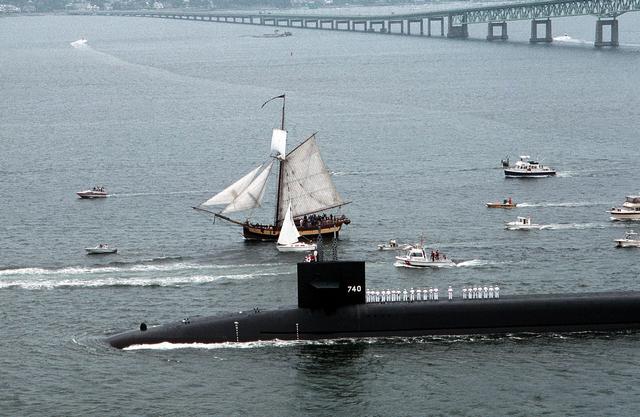
USS Rhode Island SSBN 740 (Source: US Navy)

If you've ever been to my home state you'll recognize the bridge behind the sub as the Newport Bridge. The USS Rhode Island, accompanied by the Sloop Providence, is exiting Narragansett Bay and would have passed by the Naval War College before going under the bridge. Photo was probably taken shortly after commissioning in 1994.
Update 10/22/05: Ooops, a second look at the photo above and I realize I got it backwards, they're going up the bay not leaving.

USS Providence SSN 719 (Source: US Navy)

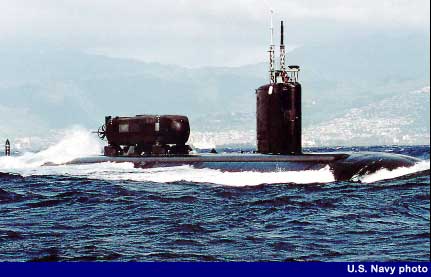
Photo is of the USS Providence SSN 719 named for the capital city of Rhode Island, is the fifth warship in Naval History to bear the name. The Providence is a Flight III boat, the first of the 688's with the Vertical Launch System (VLS) installed. Photo was taken during sea trials somewhere off the Southern New England coast.

Juliett 484 K-77 (Source: Saratoga Museum Foundation)

The Juliett 484 is a 300-foot long, diesel-powered Cold War veteran, moored at Collier Point Park in Providence, Rhode Island. The sub is the centerpiece of The Russian Submarine museum run by the Saratoga Museum Foundation and is open to the public.

Tuesday, October 18, 2005

UK Could Extend Vanguard SSBN Lifespan.

The US has already planed to extend the Ohio Class Trident SSBN lifespan from 30 to 42 years. The UK could be taking the US lead and may extend it's Vanguard Class Trident SSBN to a similar length.

From The Herald in the UK "Trident fleet faces stretched lifespan to help curb defence costs"
(Hat tip: NOSI - Naval Open Source Intelligence)

BRITAIN is to try to stretch the operational lifespan of its four Trident missile submarines until at least 2035 to maintain its nuclear deterrent at minimal cost and risk, according to naval sources.

Tony Blair and John Reid, defence secretary, have both insisted recently that no decisions have been taken, but sources say they have already scrapped alternative plans for aircraft or submarine-launched cruise missiles tipped with nuclear warheads.

They have also rejected building a new generation of submarines despite the fact that replacing ageing intercontinental missiles, installing new reactor cores, and redesigning the existing British warheads could cost more than the original £12.2bn paid for the Trident system in the 1990s.

Royal Navy Vanguard SSBN

The lead UK boat is the HMS Vanguard commissioned in 1993. If the lifespan of this class is extended to 2035 this would put it in the same timeframe for replacement as the US Tridents. The last US Trident commissioned was the USS Louisiana SSBN 743 on 9/06/1997.

As of this date, there is no large-scale design or production program in place by either country to replace thier Trident Submarines. The development of a SSBN-X Follow-on to the Trident should start in the next 10 years. This is in order to replace the first of the Tridents to be decommissioned in approximately 2029.

Monday, October 17, 2005

Beer and Submarines - odd google finds

Just for the fun of it, I googled Beer and Submarines and came up some choice links below.

Dutch beer commercial for a Walrus -- Video link -- drink up.

Brit sub layout with Food/Beer storage area.

Beer recovered from the S/S Nicomedia a victim of the The Submarine Massacre of 1915 was reproduced in 2000 and sold as "Wreck Beer" by a Swedish brewery.

A beer and a shot is known as "depth charge" at the following watering holes.

The Submarine Cocktail from Mexico.

Cold beer and Nazi subs in Chicago?

Four from the USS Dace (SSN-604) go through 62 gallons of beer, you'll find at the end of a rather long photo description.

Submarine and Luau Combination with open bar!

AND to sober everyone up read the story of Chris Beer age 18 who wanted to be a RAN submariner. Makes you want to think before you drink.

Saturday, October 15, 2005

Alvin (DSV-2) to Start Last Refit

The Deep Submergence Vehicle (DSV) Alvin is scheduled to start a 6 month refit at the Woods Hole Oceanographic Institution (WHOI) in mid October. This 40 year old sub may be undergoing it's last refit with the new deeper diving $21.6 million Alvin II scheduled to be built and delivered by 2008.

Alvin routinely undergoes a refit about every 3 years where it is completely disassembled down to the (1.9 in.) thick titanium personnel sphere. The DSV recently returned on 10/13 to Woods Hole, MA aboard it's support vessel R/V Atlantis from the Pacific.

Alvin Submerged (Source: NOAA)

The submersible Alvin is owned by the US Navy and operated by WHOI as a national oceanographic facility. The DSV typically makes eight-hour dives transporting two scientists and a pilot as deep as 4,500 meters or 14,764 feet. Specifications on the DSV can be found here.

Alvin has made more than 4,100 dives worldwide in it's forty year history. Of those dives the majority have been for Biology, Geology and Geophysics research. A NOAA streaming video of Alvin being launched from the support ship R/V Atlantis can be found here.

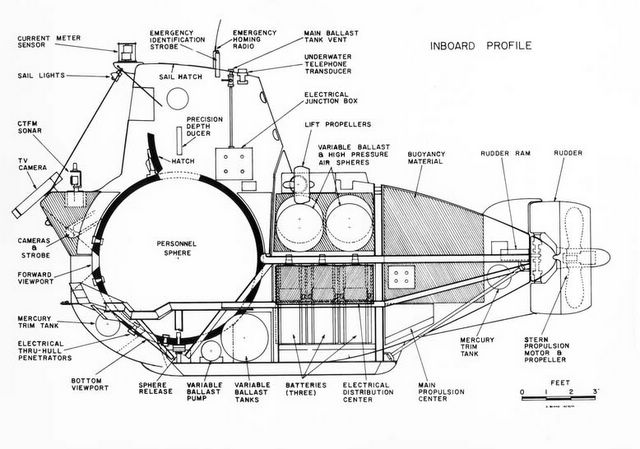
Alvin Drawing (Source: NOAA) Click on graphic for larger view.

Alvin is famous as the Geophysics research vehicle that in 1977 discovered the first hydrothermal vents off the coast of the Galapagos Islands. That discovery lead researchers to about 300 new species of animals, including bacteria, foot-long clams and mussels, tiny shrimp, arthropods, and red-tipped tube worms that can grow up to 10 ft long in some vents. The biological significance being that these creatures were the first discovered to exist totally independent of sunlight for energy and therefore an ecosystem dependent upon the these deep sea hydrothermal vents.

Other significant discoveries, accomplishments and mishaps in Alvin's 40 year history include:

1966 - Alvin assisting in the recovery of a hydrogen bomb lost when the B-52 crashed in the Mediterranean off Palomares, Spain after colliding with a refueling tanker.

1967 - Alvin was attacked by a swordfish on the bottom at about 2,000 feet. The fish became trapped in Alvin’s skin and was brought back to the surface (and cooked for dinner).

1968 - Alvin’s cradle support cables failed and Alvin slid into the water and sank to the bottom in 5,000 feet of water. The pilot sustained minor injuries and escaped while the sub was on the surface. Alvin was recovered a few months later with the assistance of the DSV Aluminaut .

1977 - Alvin discovered the first hydrothermal vents off the coast of the Galapagos Islands.

1980 - Alvin completed its 1,000th dive at the Galapagos Rift

1986 - Alvin made 12 dives to the RMS Titanic to test a prototype robotic vehicle called Jason Jr. and to photographically document the wreck.

A full chronology of Alvin's history can be found here.

Photo of 1974 refit of Alvin where a (1.9 in.) thick titanium pressure sphere replaced the HY-100 steel one, increasing it's certified dive depth (Source: NOAA)

Alvin's pilots typically have engineering degrees. Pilot certification is in some ways like earning your Submarine Dolphins, the U.S. Navy requires pilots to draw—from memory—dozens of the sub’s intricate hydraulic, ballast, electrical, and mechanical components and systems. Alvin's pilots are skilled swimmers assisting in every launch and recovery of the DSV. Additionally they are all mechanics as well as pilots; being required to make shipboard repairs during an expedition.

The sub's name Alvin is in honor of the prime mover and creative inspiration for the vehicle, Allyn Vine, a scientist at Woods Hole Oceanographic Institution. A 2004 NPR audio interview is linked here with Barrie Walden, manager, National Deep Submergence facility at the Woods Hole Oceanographic Institution on Alvin' s projected retirement.